



Why Immigration Policy Changes are Causing Long-term Financial Harm to U.S. Citizens






Geoffrey T. Sanzenbacher is a columnist for MarketWatch and a professor of the practice of economics at Boston College. He is also a research fellow at the Center for Retirement Research at Boston College.
The Detention and deportation of Immigrants sets their American Kids back
We should be careful before arresting, detaining, and deporting the immigrant parents of U.S. citizens. Separating a parent from their child is a drastic action. Among the most basic things to consider: is this parent unauthorized to be in the U.S.?
Consider the case of Gustavo Adolfo Aguilera Aguero, a man with no criminal record. Aguilera Aguero and his wife entered the country legally in 2023 using the U.S. Customs and Border Patrol’s CBP One App. Given a work permit, Aguilera Aguero was employed in the roofing industry and, during that time, his wife gave birth to a child named Jacob. A citizen under the 14th Amendment, Jacob was separated from his father when Aguilera Aguero was mistakenly arrested in March 2025, likely due to his tattoos. Despite the mistake, Aguilera Aguero was deported to a notoriously dangerous El Salvadoran prison, before being released to his home country of Venezuela. I don’t know the damage to a child’s mental health caused by this sort of forced separation. But I do know a thing or two about the financial damage. And it may be large.
You see, instability due to parental arrest and separation falls under the category of something called “Adverse Childhood Experiences,” or ACEs. A large literature documents how ACEs limit individuals’ ability to function productively in society. Before people even start their careers, ACEs reduce the probability of getting a college degree, one of the best predictors of career earnings. When older, those with ACEs experience higher rates of absenteeism and other issues at work and struggle to remain employed. Instability in employment is mirrored in the home – those with ACEs have lower rates of marriage and higher rates of divorce. And while these may sound like individual problems, they manifest themselves in ways that cost society: higher rates of welfare dependence and lower Gross Domestic Product.
But despite the large amount of research on the impact of ACEs, little is known about their cumulative effect on people’s lives. In particular, as a retirement researcher, a colleague and I wondered in a recent working paper about how various ACEs affect the accumulation of wealth over workers’ careers. When children with ACEs approach their 60th birthday, how much damage has been done to their preparedness for retirement?
The analysis used the National Longitudinal Survey of Youth 1979 Cohort (NLSY79) to follow a sample of over 5,000 people from their teenage years in 1979 until their late 50s or early 60s. In the NLSY79, parental separation can arise from divorce, death, or other circumstances (e.g., living with grandparents, in foster care, etc.). While our research may not mirror exactly what happened to Jacob – and we don’t know how the story will play out – it can at least give us a sense of how the finances of people with ACEs differ from those without them.
To this end, Figure 1 shows how median net worth differs at ages 54 to 61 for people with and without ACEs. Because families that experience ACEs differ from those that do not, the analysis controls for factors like gender, race, parental education, and parental income. The figure shows that all ACEs are associated with significantly lower net worth, even accounting for these factors. Those who experienced separation from a parent have net worth over $28,000, or 23 percent, lower than their counterparts with no ACEs.
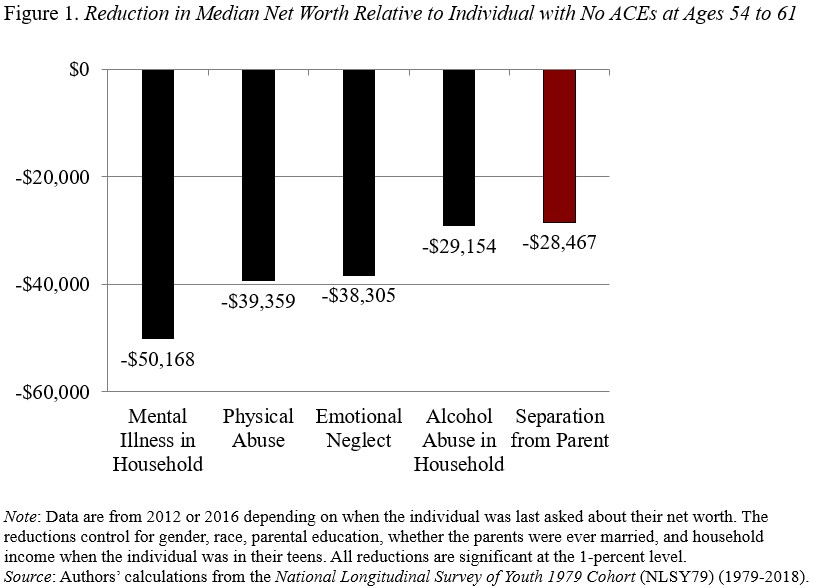
It is worth noting the difficulty in interpreting this result causally – many factors likely differ for families with ACEs that we simply can’t control for despite our efforts. However, we did find that much of the wealth gap seems connected to these children ending up with less education, earning and working less over their lifetime, and spending more time divorced. The large literature that I mentioned above documents exactly these effects due to parental separation.
This issue isn’t going away. With the Supreme Court allowing the current administration to revoke legal status for over 600,000 Venezuelans, it seems likely that many people that came here legally – as did Aguilera Aguero – may soon be unauthorized to stay. Is it worth doing long-term damage to our citizens by deporting a parent that came here legally but, through a policy change, lost their protected status? Our government seems content to deport well-meaning parents, whatever the collateral damage to their American children.