



Health Shocks and Annuity Choices





The brief’s key findings are:
- As U.S. financial firms consider embedding annuities as the default in 401(k)s, it’s worth assessing the potential risks as well as the gains.
- The analysis uses data from a major Swedish pension plan to see how a cancer diagnosis affects participants’ payout decisions when annuities are the default.
- It finds that those diagnosed with cancer before retirement are less likely to annuitize than those diagnosed after, but the response is surprisingly small.
- A supplemental lab experiment found that the small response is likely due to having an annuity as the default.
- Thus, default annuitization should be weighed against the costs of guiding people toward choices that may not reflect changed circumstances.
Introduction
As U.S. financial firms push toward embedding life annuities in 401(k) plans, it is useful to assess the risks, as well as the gains, associated with making annuitization the default distribution option. While default strategies have proven highly effective during the accumulation phase, approaches that work well for retirement saving may have unintended adverse consequences during the decumulation phase.
On the positive side, annuities protect people from outliving their resources, shield purchasers from market risks, and provide comfort by guaranteeing a regular income to cover necessary expenses. Annuities also can provide individuals with more income than they could get on their own, because the provider pools the experience of a large group and pays benefits to those who live longer out of premiums paid by those who die early. This mechanism should make annuities attractive to those who expect to live long and unattractive to those who expect to die early. The quintessential example of a person expecting a short remaining lifespan is someone with a serious health diagnosis. The question is, how much does knowing that death will likely be sooner rather than later reduce the demand for annuities?
This brief, which is based on a recent study, uses data from a major Swedish occupational pension plan to see how a first-time cancer diagnosis affects the demand for annuities.1 While the findings demonstrate that a cancer diagnosis significantly reduces the likelihood of selecting an annuity, the magnitude is surprisingly small given the known impact of a cancer diagnosis on life expectancy. One likely reason for the limited response is that the annuity is the default option in this setting. Hence, this study also conducts a laboratory experiment to explain the role of default options under changing survival expectations.
The discussion proceeds as follows. The first section describes the institutional setting, the sample, and the regression analysis used to estimate the impact of a cancer diagnosis on annuity demand. The second section presents the results, which show that a diagnosis reduces demand by only 4 percentage points. To demonstrate the implications of this modest response, the third section shows that those diagnosed with cancer choosing the annuity option would forfeit 33 percent of the expected present discounted value of an alternative guaranteed five-year-payment option. Given this large financial loss, the fourth section describes the results of the experiment to gauge the influence of defaults on annuity selection. The fifth section briefly examines other factors – including low financial literacy, tolerance for risk, and family risk pooling – that could affect the outcome, finding that none of them have a statistically significant impact.
The final section concludes that individuals’ modest response to a cancer diagnosis represents a substantial financial loss. Evidence from the complementary lab experiment indicates that this limited adjustment is driven by the influence of a default option that reduces responsiveness to private health information. Thus, while default annuitization, either full or partial, is commonly recommended in the withdrawal phase by both scholars and regulatory bodies, it should be weighed against the personal and social costs of guiding individuals toward financial choices that do not reflect changed circumstances or individual preferences.
The Effect of a Cancer Diagnosis on Annuity Demand
To estimate how a cancer diagnosis impacts annuity demand, this study uses Swedish pension data. Sweden’s pension system has two main pillars: a universal public pension and a quasi-mandatory occupational pension. The analysis focuses on payout choices under the occupational pension for private-sector white-collar workers.
Under this plan, the default payout option is an annuity starting at age 65. Alternatively, individuals can choose fixed-term payouts over 5, 10, 15, or 20 years. Once selected, the payout decision is irreversible, and once a fixed term ends, it cannot be converted into a new annuity.
Three months before turning 65, individuals receive a letter from the managing company outlining expected monthly income under the default annuity and informing them of the option to select a fixed-term payment. Although the communication is neutral in tone, the monthly amount for a fixed-term payout is shown only of a seven-page letter.
Based on extensive literature that relates insurance choices to risk type, the probability of annuitizing is assumed to be a function of longevity. A cancer diagnosis significantly impacts an individual’s expected longevity.
To estimate the impact of receiving new information about longevity on the demand for annuities, retirees are separated into two groups: a treatment group of individuals diagnosed with cancer within three years before retirement, and a control group of individuals who experienced a similar diagnosis within three years after retirement.
The task is then to estimate a regression equation that relates the probability of choosing an annuity to having a cancer diagnosis before retirement. In the equation, the diagnosis is an indicator variable that takes the value of one if the retiree experienced a cancer diagnosis before making an annuity choice and zero otherwise, as follows:
Prob (choosing annuity) = f (cancer diagnosis before retirement + individual characteristics)
The equation includes a rich set of individual characteristics that may influence annuity decisions. Demographic variables include gender, marital status, number of children, and highest level of education. Health indicators include the number of hospitalization days, the number of unique drugs consumed in the year before retirement/diagnosis, and receipt of sickness or disability benefits. In addition, the equation includes the individuals’ average disposable income in the five years preceding retirement, as well as their real and financial assets.
The dataset covers 241,896 retirees born between 1943 and 1953 and includes detailed records of retirement claims from May 2008 through December 2015, specifying the month and year of pension claiming and the chosen payout duration. The “cancer sample” consists of 30,062 individuals, 14,945 who were diagnosed in the three years before retirement and 15,117 who were diagnosed after retirement. The key coefficient of interest is that of the variable indicating diagnoses before retirement, which shows how much a cancer diagnosis reduces the demand for an annuity.
Results
The analysis is based on the assumption that whether a cancer diagnosis occurs before or after retirement is essentially random. This assumption means that the treatment and control groups, those with and without a change in perceived longevity risk at the time of the retirement decision, should be comparable in all respects, except for the diagnosis timing and the resulting decision. Thus, the exercise is very much like a natural experiment and the results can be construed as causal, not just a relationship between a diagnosis and a reduction in demand.
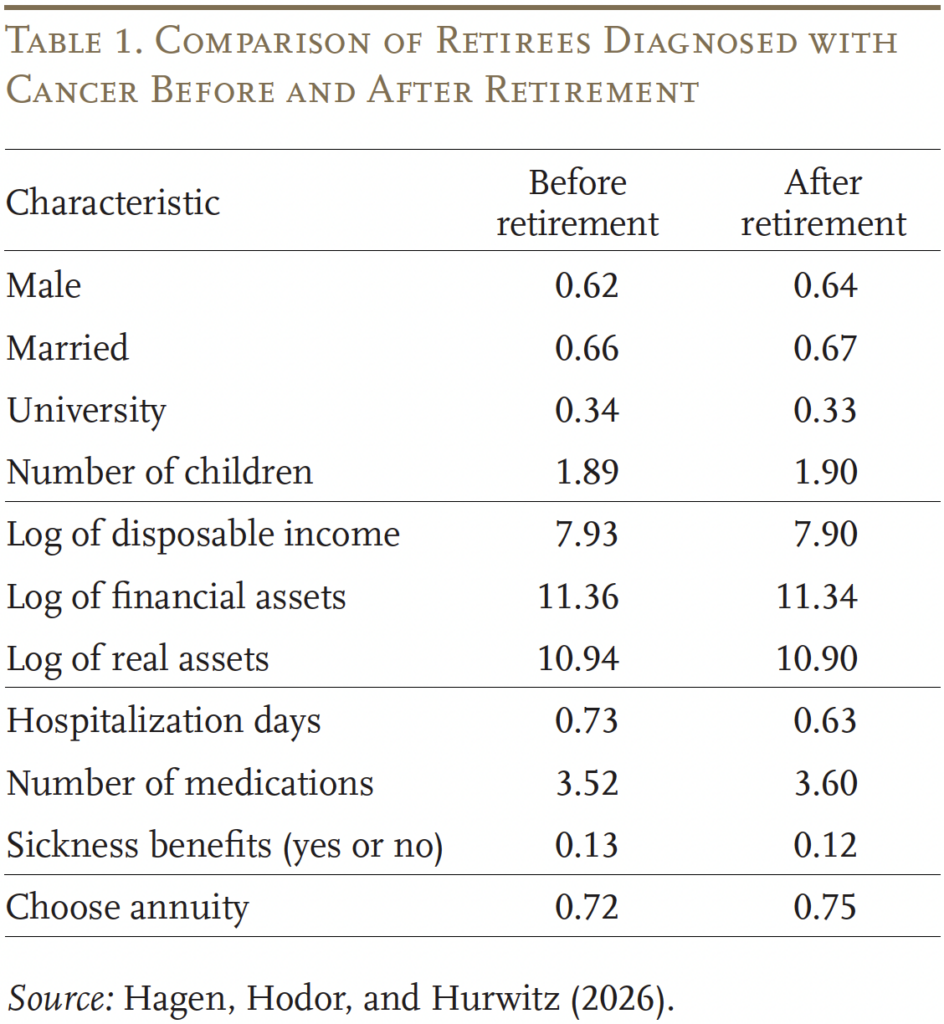
Table 1 compares the two groups across selected demographic, health, and financial characteristics. They are virtually identical, except for the share choosing the annuity. Individuals diagnosed after retirement have annuitization rates of 75 percent, similar to the general population, compared to an annuitization rate of 72 percent for those diagnosed before retirement, consistent with a behavioral adjustment following a shift in perceived longevity.
To isolate the impact of a cancer diagnosis before retirement on demand for annuities requires estimating the equation described above. The equations are estimated both with and without the individual characteristics, but, given the similarity of the two samples, the results are very close (see Figure 1).
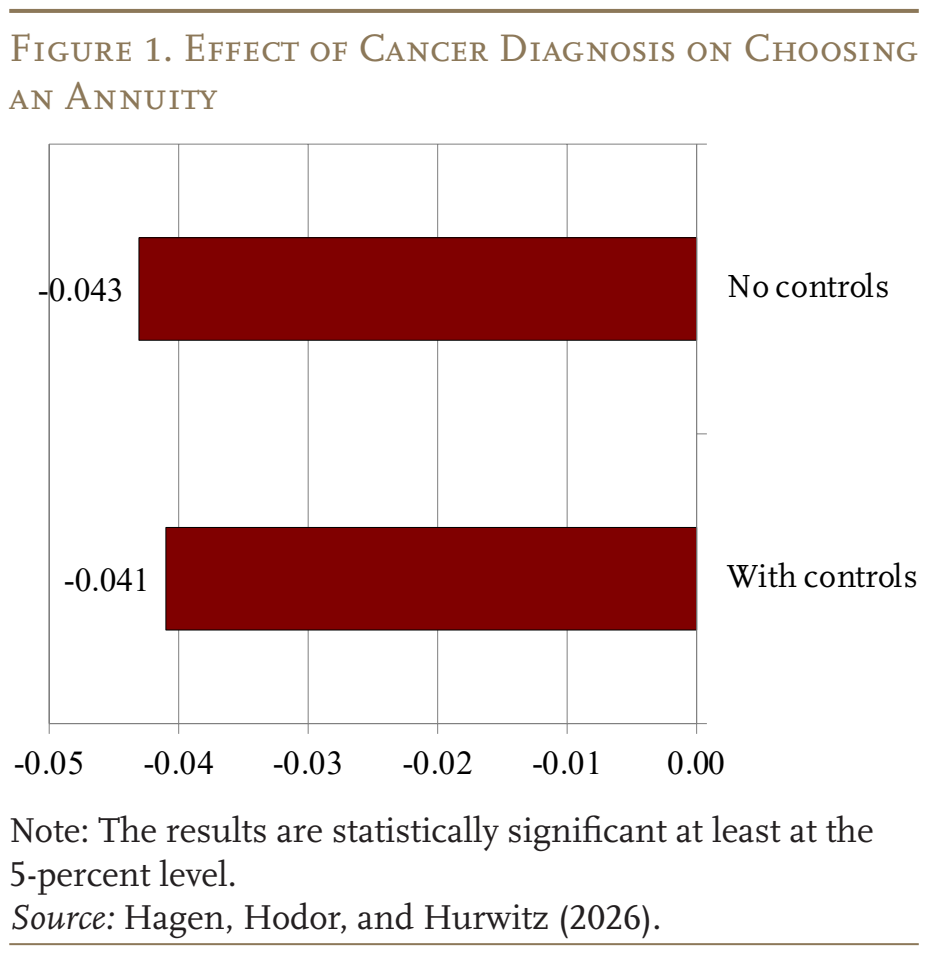
Both show that individuals diagnosed with malignant cancer were about 4 percentage points less likely to choose an annuity relative to individuals diagnosed post-retirement. This finding supports the hypothesis that those with shorter longevity expectations are less likely to buy an annuity.
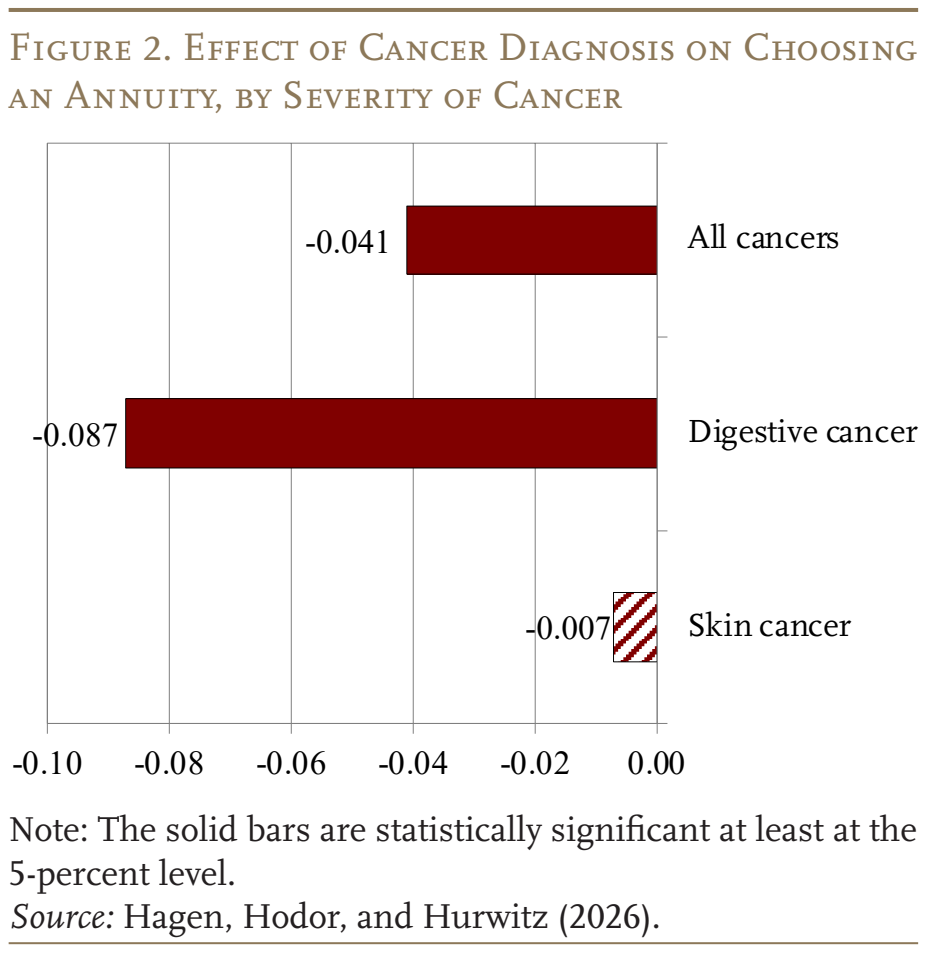
The results also show that the severity of the cancer diagnosis matters (see Figure 2). A diagnosis of digestive cancer, which is associated with low survival probabilities, leads to a significant 8.7-percentage-point decrease in the demand for annuities. In contrast, a diagnosis of skin cancer, which is less lethal, results in no significant change in annuity demand.
Financial Implications of the Demand Response
To provide a more comprehensive understanding and quantify the implications of the main finding, the next step is to calculate the monetary value of the adverse-selection estimate. This exercise involves calculating the expected present discounted value (EPDV) of an annuity and comparing it with the EPDV of the five-year payout option.
Table 2 shows that for individuals diagnosed with any form of cancer, the EPDV of an annuity is $44,455, whereas the corresponding value for the five-year payout option is $66,012. As a result, the average individual with a cancer diagnosis who chooses the annuity forgoes $21,558 or 32.7 percent of the EPDV of the five-year payout option. In the case of individuals with digestive cancer, the loss is 36.6 percent of the five-year payout option; for those with skin cancer, the loss is 29.5 percent. These substantial financial differences indicate the economic significance of severe longevity shocks on the value of annuities.
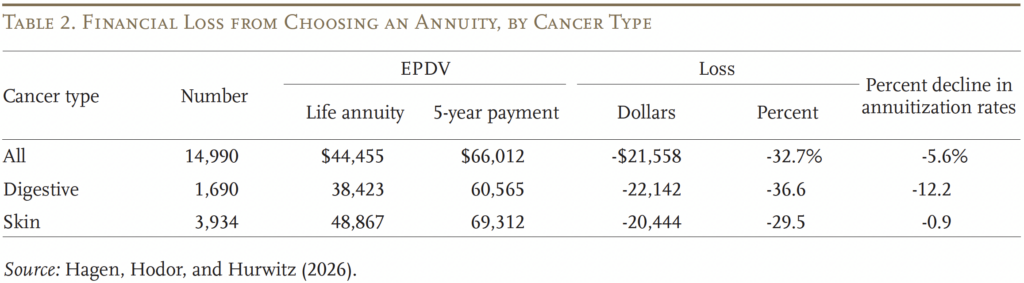
The relationship between the reduction in the EPDV and the change in annuity demand provides a measure of price sensitivity (demand elasticity). For all cancers, the average value declines by 32.7 percent, whereas annuity uptake falls by 5.6 percent, implying an elasticity of (5.6/32.7=) 0.17, a relatively modest behavioral response.2
Elasticity varies significantly across diagnoses. Digestive cancers, which show the largest decline in annuitization and the largest drop in value, exhibit a relatively high elasticity of 0.33. For skin cancer, however, the elasticity is just 0.05, despite a significant reduction in the EPDV.
One note in evaluating these results – because the annuitization decision is irreversible in the Swedish plan, individuals may act more cautiously, reducing responsiveness to longevity shocks compared with settings where reversal is possible. Thus, these estimates likely represent a “worst-case” scenario where caution suppresses responsiveness.
Contribution of Default to Modest Response Results
The crucial question is why individuals have such a modest response to a cancer diagnosis. One obvious factor in the Swedish situation is that annuitization is the default. Prior literature has shown the substantial effect of defaults in a range of markets, including savings plan participation, pension contributions, asset allocation, rollovers, and decumulation.3 The issue in this study, however, is not whether defaults impact annuitization, but rather how a default affects responses to new information about longevity.
To address that question, this study includes an experiment in which participants are asked to allocate funds between an annuity and a lump sum.4 Participants were students at the Hebrew University of Jerusalem and Tel-Aviv University.
The participants were randomly assigned to either low- or high-longevity conditions, with or without a default option, resulting in four different treatment groups. Participants who were randomly assigned to the default treatment were initially presented with a prefilled choice of a full annuity. Those assigned to the no-default treatment were not presented with a default option.
To introduce uncertainty about longevity, a computer was used to draw lifespans from a predefined distribution. Specifically, for participants assigned to the high-longevity condition, the computer drew longevity from a range spanning 0 to 400 months. In contrast, for those in the low-longevity condition, longevity was drawn from a range of 0 to 200 months. The annuity pricing was based on an expected lifespan of 200 months, the average for the high-longevity group. Participants were also assigned a value of monthly consumption.5
As in real-life circumstances, participants were informed that the results of the survival draw (i.e., how many months they will live) would only be revealed after the payout choice was made, leaving uncertainty about the exact amount needed at the time of the decision. Under this setup, individuals must make retirement payment choices based on their own expectations of longevity, which vary based on their assignment to the low- and high-longevity groups. Participants then received a small upfront fee and subsequent modest fees to the extent they made prudent decisions.6
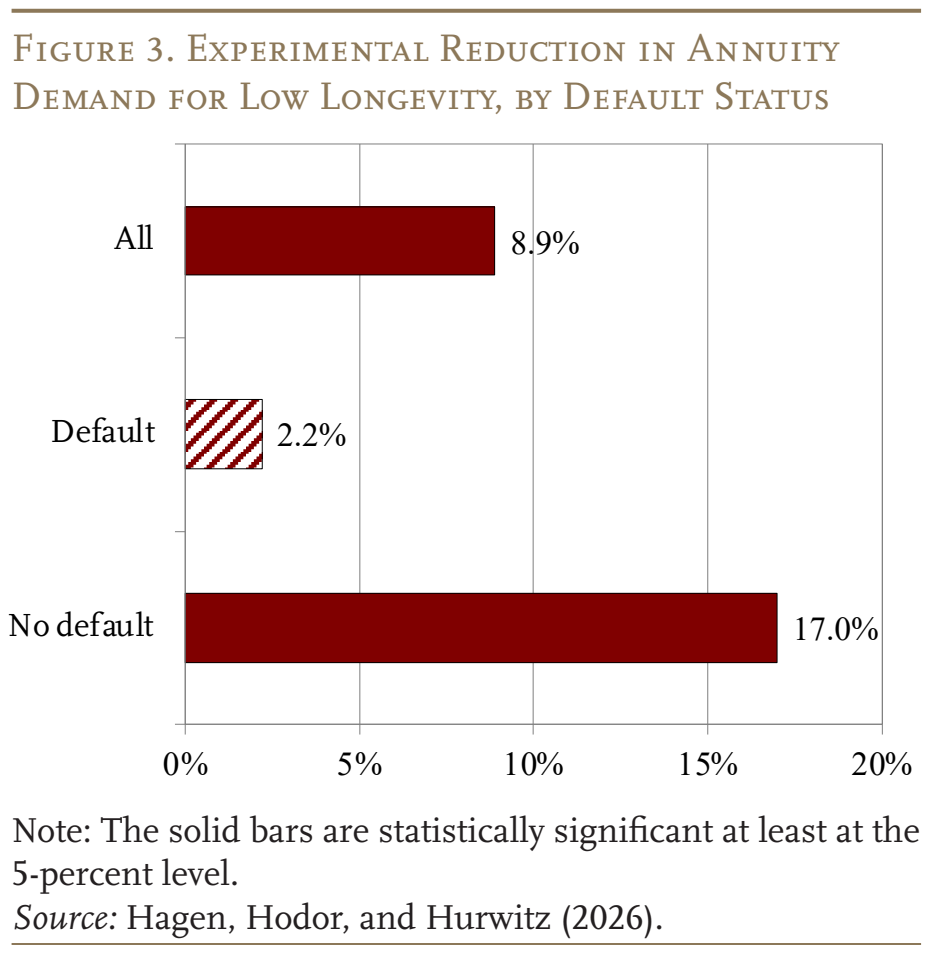
The main result from the experiment is that a default matters a lot. Low-longevity individuals, on average, reduce their demand for an annuity by 8.9 percentage points. This average, however, is the result of a 2.2-percentage-point decline when the annuity is the default and a 17-percentage-point decline when no default is in effect (see Figure 3). That is, the default option significantly masks the impact of longevity expectations and helps explain the relatively small cancer diagnosis response observed in the administrative data from the Swedish pension plan.
Other Possible Explanations
The final question is whether other factors – low financial literacy, tolerance for risk, family risk pooling, and prior experience – could also help explain the modest effect of receiving a cancer diagnosis on annuity choice.
First, individuals with lower financial literacy may lack full awareness of the financial implications of annuitization choices, which could lead them to opt for annuities regardless of the change in survival probability. To explore this explanation, we compared the response to a cancer diagnosis among individuals majoring in financially related subjects to the response of those without such majors. The difference here is not statistically significant.
Second, prior research suggests that risk preferences can help shape insurance demand.7 The notion we tested here is that an individual’s risk preferences impact portfolio composition, particularly the allocation to high-risk assets. The results show that the entire response to a cancer diagnosis comes from risk-averse individuals, with an effect size similar to that of the full cancer sample. In contrast, risk-tolerant individuals do not adjust annuity demand following the cancer diagnosis. Overall, the results suggest that risk preferences alone are insufficient to explain the small adverse-selection effect.
Third, the potential for families to pool risk means that marital status can shape individuals’ responses to a cancer diagnosis. Prior research suggests that the utility gain from annuitization is smaller for couples than for single individuals because married individuals can pool longevity risk.8 To study this issue, the responses of married individuals are compared with those of single individuals. The results show that the reduction in demand for an annuity following a cancer diagnosis is smaller among married individuals. This finding is contrary to expectations, and the difference is not statistically significant.
Finally, it could be that practical experience helps individuals make more informed annuity decisions. Each participant in the experiment actually went through the process twice, in order to learn the setting. We found that the participants showed a significantly stronger response to the longevity shock in the second round compared to the first round, reflecting their greater familiarity with the task and the financial consequences of the choices. This evidence indicates that limited hands-on experience with financial decision making may explain the weak adverse selection effect.
Conclusion
This study examines how a severe shock to perceived longevity – a first-time cancer diagnosis – affects the demand for annuities in a Swedish occupational pension plan for white-collar workers. The results show that individuals diagnosed with cancer shortly before retirement are 4 percentage points less likely to annuitize compared with those diagnosed immediately after retirement, despite otherwise similar observable characteristics. On average, the diagnosis results in a reduction of $21,558, or 33 percent, relative to what they would have received under a five-year payout. The results from an incentivized, pre-registered lab experiment reveal that default options can mask the effect of private health information.
The bottom line is that, while default annuitization, either full or partial, is commonly recommended in the withdrawal phase by both scholars and regulatory bodies, it should be weighed against the personal and social costs of guiding individuals toward financial choices that do not reflect changed circumstances. Tailored interventions, such as targeted financial education, personalized advice, and informational nudges, can help individuals navigate these complex decisions, particularly when facing health shocks.
References
Agnew, Julie R., Lisa R. Anderson, Jeffrey R. Gerlach, and Lisa R. Szykman. 2008. “Who Chooses Annuities? An Experimental Investigation of the Role of Gender, Framing, and Defaults.” American Economic Review 98(2): 418-422.
Bateman, Hazel, Christine Eckert, Fedor Iskhakov, Jordan Louviere, Stephen Satchell, and Susan Thorp. 2017. “Default and Naive Diversification Heuristics in Annuity Choice.” Australian Journal of Management 42(1): 32-57.
Beshears, Jonathan, James Choi, David Laibson, and Brigitte Madrian. 2009. “The Importance of Default Options for Retirement Saving Outcomes.” In Social Security Policy in a Changing Environment, edited by Jeff Brown, Jeff Liebman, and David Wise, 167-195 Chicago, IL: University of Chicago Press.
Bütler, Monika and Federica Teppa. 2007. “The Choice Between an Annuity and a Lump Sum: Results from Swiss Pension Funds.” Journal of Public Economics 91(10): 1944-1966.
Bütler, Monika, Stefan Staubli, and Maria Grazia Zito. 2013. “How Much Does Annuity Demand React to a Large Price Change?” Scandinavian Journal of Economics 115(3): 808-824.
Chalmers, John and Jonathan Reuter. 2012. “How Do Retirees Value Life Annuities? Evidence from Public Employees.” Review of Financial Studies 25(8): 2601-2634.
DeMeza, David and David Webb. 2001. “Advantageous Selection in Insurance Markets.” RAND Journal of Economics 32(2): 249-262.
Finkelstein, Amy and Kathleen McGarry. 2006. “Multiple Dimensions of Private Information: Evidence from the Long-term Care Insurance Market.” American Economic Review 96(4): 938-958.
Hagen, Johannes, Michal Hodor, and Abigail Hurwitz. 2026. “Health Shocks and Annuity Choices.” Management Science, Articles in Advance: 1-18.
Hanming, Fang and Zenan Wu. 2018. “Multidimensional Private Information, Market Structure, and Insurance Markets.” RAND Journal of Economics 49(3): 751-787.
Kotlikoff, Laurence and Avia Spivak. 1981. “The Family as an Incomplete Annuities Market.” Journal of Political Economics 89(2): 372-391.
Kotlikoff, Laurence, John Shoven, and Avia Spivak. 1986. “The Effect of Annuity Insurance on Savings and Inequality.” Journal of Labor Economics 4(3, Part 2): S183-S207.
Unger, Franziska, Martina Steul-Fischer, and Nadine Gatzert. 2024. “How Default Effects and Decision Timing Affect Annuity Uptake and Health Consciousness.” Geneva Papers Risk Insurance-Issues Practice 49(1): 180-211.
Endnotes
- Hagen, Hodor, and Hurwitz (2026). ↩︎
- Bütler, Staubli, and Zito (2013) reported a 16.8-percent decrease in the demand for annuities in response to a reduction of 7.9-percent in annuity value, implying higher demand elasticity compared with our findings. In contrast, Chalmers and Reuter (2012) observed a more limited response, suggesting low elasticity. Although these studies examined variation driven by actual price or conversion factor changes, our approach instead relies on exogenous shifts in life expectancy that affect the perceived value of annuities. ↩︎
- Beshears et al. (2009). And studies of Switzerland, where annuitization serves as the default option in many funds, show that it leads to higher annuitization rates (Bütler and Teppa 2007). Experimental studies offer mixed results regarding the role of defaults in annuitization choices. Although an Australian experiment (Bateman et al. 2017) found a substantial impact of defaults on annuity choices, an American experiment (Agnew et al. 2008) suggested that defaults did not significantly affect decisions. A more recent study also finds no evidence supporting a default effect (Unger, Steul-Fischer, and Gatzert 2024). ↩︎
- Although the administrative data do not include a lump-sum option, we introduced it in the experiment to ensure that participants and responses are not constrained by the absence of such a choice. ↩︎
- The experiment further incorporates uncertainty about individuals’ future expenses. Participants in all conditions were informed that their monthly consumption would be either 3,000, 6,000, or 9,000 currency units, with these amounts being evenly distributed. To simplify the decision-making process, the consumption level was kept constant for each participant over the lifetime. ↩︎
- That is, given that retiring without income or savings is highly undesirable, participants face penalties for depleting all funds. If the annuity and remaining lump-sum withdrawal are insufficient to cover consumption costs, participants receive only the show-up fee. Throughout the experiment, researchers monitored participants’ monthly balances, accounting for both choices and variable realizations. Surpluses are accumulated when monthly income exceeds consumption, whereas deficits are deducted from the lump sum when possible. ↩︎
- See DeMeza and Webb (2001), Fang and Wu (2018), and a relationship previously explored in the context of long-term care and health insurance by Finkelstein and McGarry (2006). ↩︎
- Kotlikoff and Spivak (1981) and Kotlikoff et al. (1986). ↩︎



Hagen, Johannes, Michal Hodor, and Abigail Hurwitz. 2026. "Health Shocks and Annuity Choices" Issue in Brief 26-15. Chestnut Hill, MA: Center for Retirement Research at Boston College.