

Are the Careers of Older Workers Being Cut Short by AI?





The brief’s key findings are:
- Workers ages 55+ are just as exposed to AI as mid-career workers, so how might it impact their careers?
- The analysis looks at how job exits changed from before to after ChatGPT launched, based on level of AI exposure.
- The results show a rise in job exits for those with high-exposure jobs (e.g., programmers and accountants) since the surge in AI usage.
- Even with AI, though, many high-exposure jobs still have lower exit rates than low-exposure jobs, which tend to require more physical work.
- The bottom line: as many policy experts urge longer worklives, AI could be pushing some older workers in the opposite direction.
Introduction
Since the launch of ChatGPT in November 2022, AI’s potential impact on labor markets has been a growing worry. This concern has centered on the replacement of workers, with a special focus on younger people.1 Recently, however, some anecdotal evidence has suggested AI could be impacting those near retirement as well. Specifically, some late-career workers may be leaving work earlier than planned, either involuntarily due to job loss or voluntarily due to the challenge of learning a new technology.2 But anecdotal evidence is one thing. Does hard data support the notion that older workers exposed to AI are cutting their careers short?
To answer this question, this brief combines Current Population Survey (CPS) data with information on AI exposure from the Digital Planet Initiative at Tufts University. AI exposure is defined based on how well an occupation’s tasks can be performed by AI. The analysis uses the period before ChatGPT’s launch in November 2022 as a “pre-treatment period” for estimating occupation trends before the recent explosion of AI. This approach is important since the jobs more exposed to AI today differed from the less-exposed jobs even before AI use became widespread. Specifically, then, the brief addresses whether workers ages 55+ who are more exposed to AI are leaving work more often than similar workers before ChatGPT’s launch.
The brief proceeds as follows. The first section provides background on the potential impact of AI on older workers. The second section describes the datasets and the empirical approach. The third section presents the results. The final section concludes that – since the launch of ChatGPT – older workers in jobs more exposed to AI are somewhat more likely to exit from work and transition to unemployment. Given the rapid growth of AI and the importance of longer careers to achieve a secure retirement, policymakers may want to take note of this pattern now.
Background
The impact of AI on any workers, let alone those near retirement, remains an open question. On the one hand, AI can automate certain tasks, potentially displacing workers with those job responsibilities.3 For example, consider an editor of news articles. Such a worker has several tasks that could be automated by generative AI, including correcting spelling and grammar, verifying facts and figures, and evaluating the article’s readability.4 But, on the other hand, an editor’s job also requires developing new content and story ideas that consider audience interests, something AI may struggle with. To the extent that generative AI makes editing and verification tasks easier, it could allow editors to become so much more productive at developing content that demand for them goes up, not down…provided that they adopt the new technology.5
This example suggests three ways that AI could impact older workers’ career trajectories – two that lead to exit and one that extends working lives. The first is replacement through automation that leads either to unemployment (i.e., out of work but still looking) or exit from the labor force entirely.6 Second, pressure to adopt AI could cause workers who want to avoid learning it to head for the exits, either to look for an AI-proof job or to retire. Some research has suggested that these sorts of adoption-related quits occurred around the spread of personal computers.7 Or, third, generative AI could keep people working longer, as higher productivity increases wages and workers are able to focus on more engaging tasks. Indeed, other research on personal computers suggested that for those comfortable with their adoption, the result was longer, not shorter, careers.8
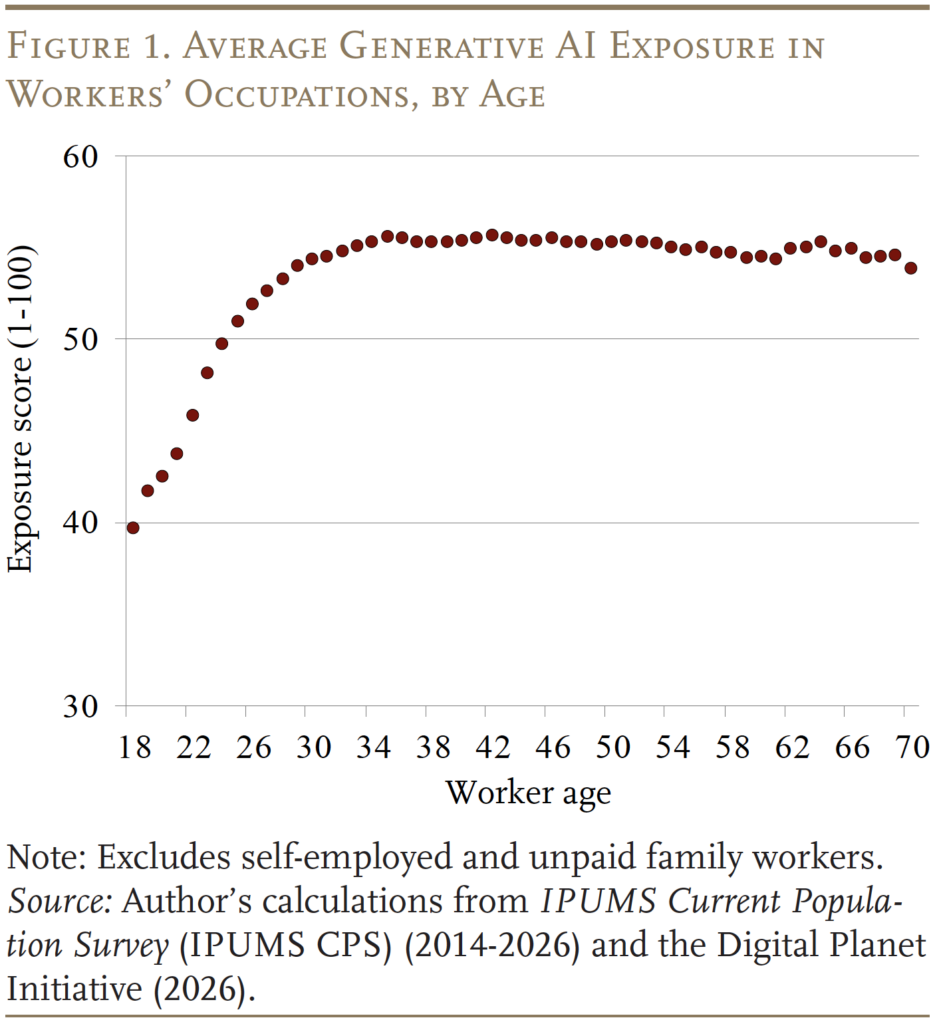
Which of these possibilities plays out is important. Figure 1 uses Digital Planet data (discussed in detail below) to show workers’ exposure to generative AI. It turns out that workers near retirement are in jobs that are just as exposed to this technology as those in the middle of their careers.
So, is there any evidence on whether exposure of older workers to AI is leading them to adopt this technology or avoid it? Here, evidence exists on both sides. Recent research suggests that a non-trivial fraction of older workers are using AI. One survey found that 18 percent of workers ages 50-64 use generative AI.9 Another paper focused only on higher-ranked decision makers and found a 42-percent usage rate for those 55+.10 The downside is that both studies also found that these adoption rates were much lower than for workers in their 30s and 40s. An AARP survey captures some of older workers’ reticence. While 18 percent of workers 55+ saw AI solely as an opportunity, 28 percent saw it solely as a threat.11 The question is how these forces are playing out in the labor market.
Data and Methodology
This section starts with the data – the Current Population Survey (CPS) and the Digital Planet AI Exposure Index – and then turns to the methodology.
Current Population Survey
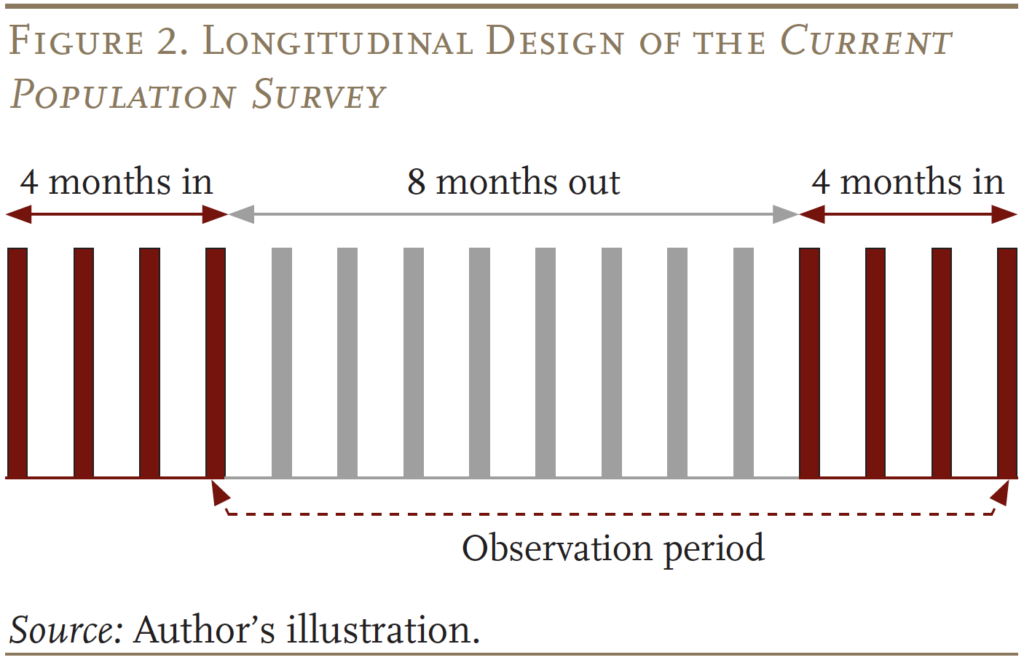
The source of individual-level data used is the CPS’s Basic Monthly questionnaire, which the U.S. Bureau of Labor Statistics uses to estimate monthly unemployment. Specifically, the analysis uses the panel nature of the CPS whereby respondents are surveyed for four straight months; then are out of the sample for eight months; and then re-enter the sample for another four months. The analysis looks at how the employment status of workers ages 55+ changed between their fourth month in the survey and their last month in the survey, one year apart (see Figure 2). The focus is on individuals who were first observed between January 2014 and April 2025. Because jobs were impacted differently by COVID-19, the analysis excludes those whose second observation would have occurred from March 2020 to December 2021, as their continued employment would have been affected by the pandemic.
The CPS also collects data on demographics and job characteristics that can be used to account for any changes in the population or nature of work before and after the launch of ChatGPT. Importantly, these job characteristics include workers’ occupations, which are used to merge the CPS data onto the Digital Planet AI Exposure estimates.
Digital Planet AI Exposure Index
The AI Exposure Index is not meant to measure simply how vulnerable a job is to replacement or automation. Instead, it aims to capture how well AI can perform the various tasks that make up the workload of that job. Clearly, this type of measure could be associated with worker replacement. But as discussed above, if AI does rote tasks well, exposure to AI could free up workers to focus on tasks that increase their productivity. The question this brief addresses is which outcome seems to be dominating so far.
The AI exposure score runs from 0 to 100, and is the weighted average of measures from three separate studies that capture three different aspects of AI. The measures are presented below in order of their importance in the exposure metric:12
- Tasks Affected by Large Language Models (LLMs): captures the share of a job’s tasks that could experience time savings of over one half using LLMs. The authors asked both human experts and ChatGPT-4 to evaluate which tasks could experience such savings, with both sources estimating that 14 percent of tasks could have these reductions.13
- Tasks Suitable for Machine Learning: examines the share of a job’s tasks that could likely use machine learning tools successfully. For example, it covers tasks with well-defined inputs and outputs, with no need for detailed explanations of how decisions were made, or with no special dexterity or physical skills required.14
- Abilities Exposed to AI Developments: looks at how AI beyond LLMs can mimic human abilities required for jobs. For example, AI may excel at some sensory abilities required for tasks, like speech recognition, while struggling with others, like explosive strength. The authors use a crowd-sourced survey to evaluate which abilities are amenable to AI technologies.15
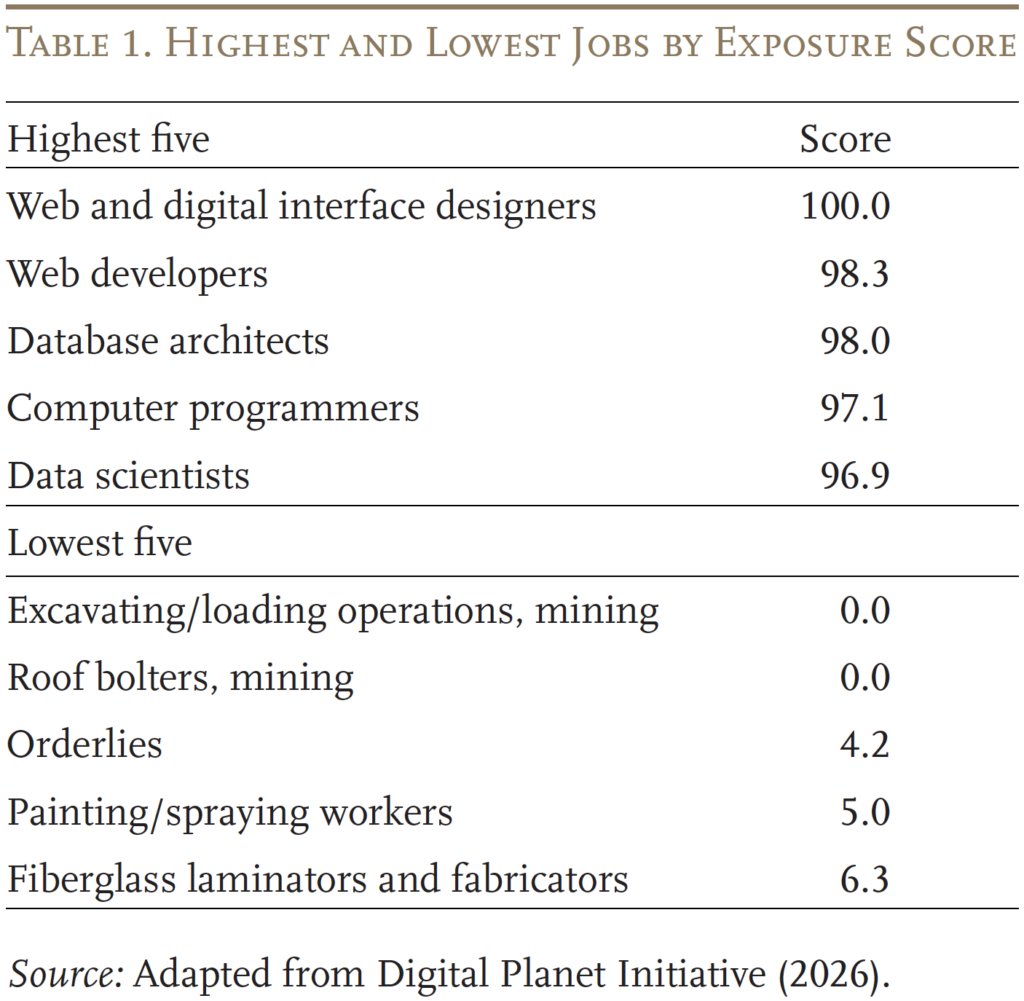
Exposure scores run the gamut – the bottom fifth of workers have scores below 30 and the top fifth of workers have scores above 70. For illustrative purposes, Table 1 highlights the five highest and five lowest jobs by the Digital Planet AI Exposure score metric. The commonality among the highest five jobs seems to be working with data combined with coding. The lowest five jobs have tasks that require working physically with machinery or people.
Methodology
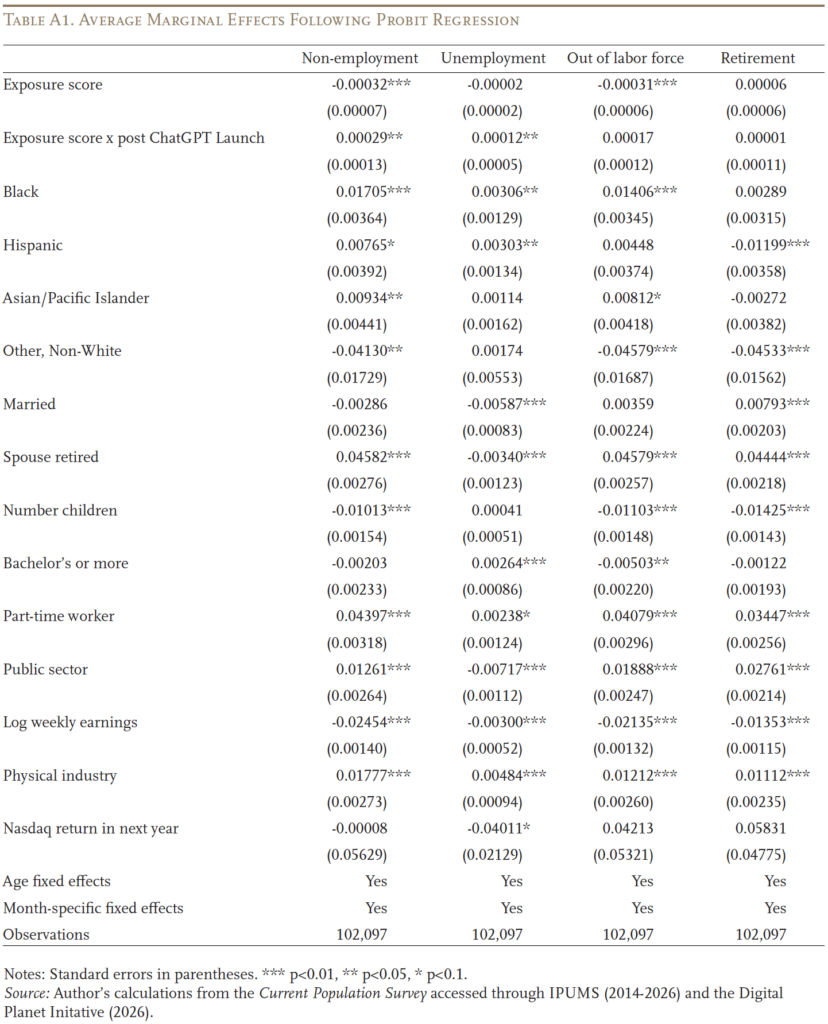
To estimate how AI exposure impacts late-career employment, workers in the CPS are first matched to their occupation exposure scores.16 The next step is to conduct a regression analysis estimating the probability of several employment changes. The broadest outcome is whether the person has stopped working one year after being observed employed. Then, three more specific outcomes are examined, all of which are subcategories of “stopped working”: 1) not working due to unemployment (i.e., looking for work but can’t find it); 2) not working and not looking for work, which includes retirement; and 3) not working and claiming specifically to be retired.
The regression analysis includes two measures of AI exposure: 1) the worker’s exposure score any time that the individual was observed; and 2) a variable taking on either a value of zero for workers first seen prior to the launch of ChatGPT or their actual exposure score otherwise.17 The first variable is meant to capture the fact that more exposed jobs likely had different work outcomes than less exposed jobs prior to ChatGPT’s launch. For example, a web developer (high exposure) is likely to have a longer career than a painter (low exposure) due to the less physical nature of the work. The second variable captures any change in job exit after ChatGPT’s launch associated with a higher exposure score. Did web developers see a relative increase or decrease in the rate at which they left their jobs compared to painters?
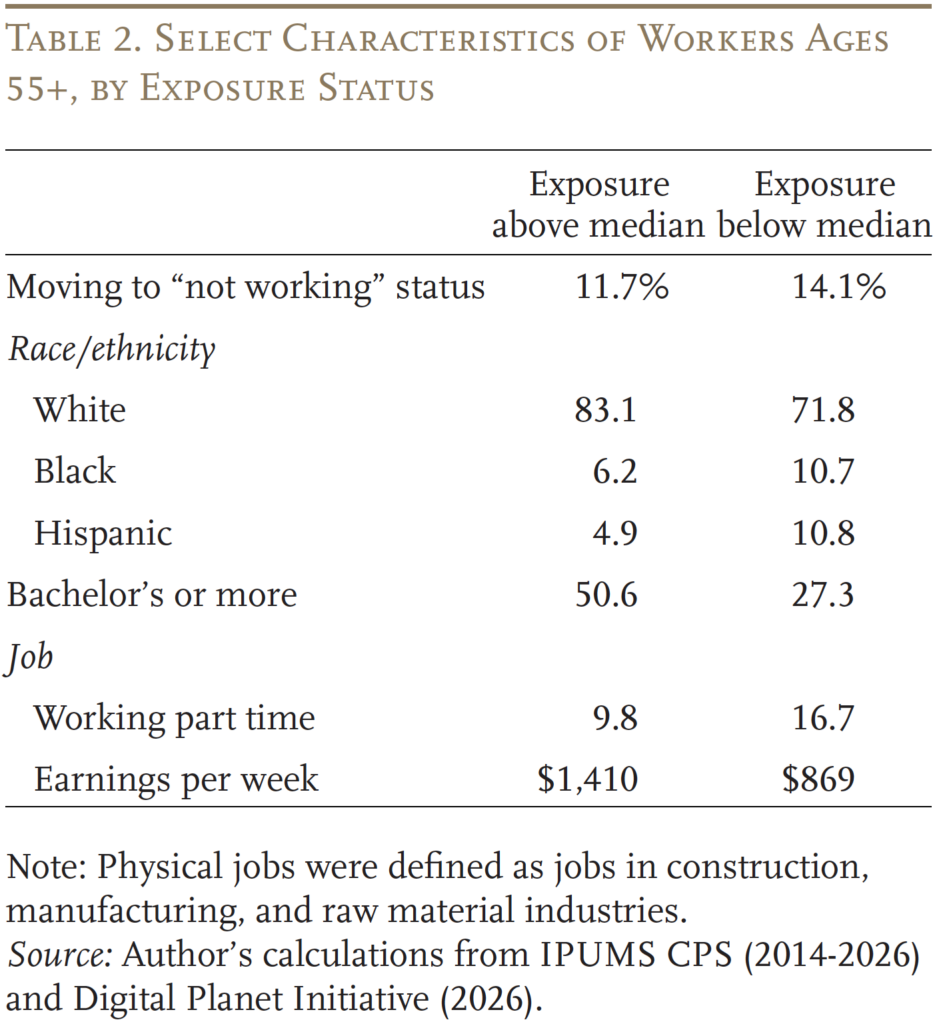
Table 2 summarizes some of the key variables in the analysis separated by whether a worker is above or below the median exposure in the sample. The table shows that across the entire period examined, workers in high-exposure jobs were less likely to leave employment than their peers with less exposure (11.7 percent versus 14.1 percent, respectively). Exposed workers are also more likely to be White, much more likely to have a college degree, and also earn more than workers with low exposure. To account for these differences, which may drive those longer careers, the regression controls for both demographic/familial and job-related characteristics. The regression is:
Probability of retiring = f (exposure score, exposure score post-ChatGPT launch, and demographic/job characteristics)
Results
Figure 3 shows the association between a one-standard-deviation increase in AI exposure and the different employment outcomes considered.18 The figure suggests that prior to the launch of ChatGPT (gray bars), older workers in AI-exposed jobs were significantly less likely to leave employment even controlling for the characteristics in Table 2. However, after the ChatGPT launch (red bars), AI-exposed jobs saw relative increases in total transitions out of work and specifically to unemployment (but not out of the labor force). The types of jobs exposed to AI used to have a relative advantage with respect to career longevity. In the post-ChatGPT era, the nearly offsetting bars for “not working” suggest that this advantage has been greatly reduced, with a significant share of the increase due to unemployment.
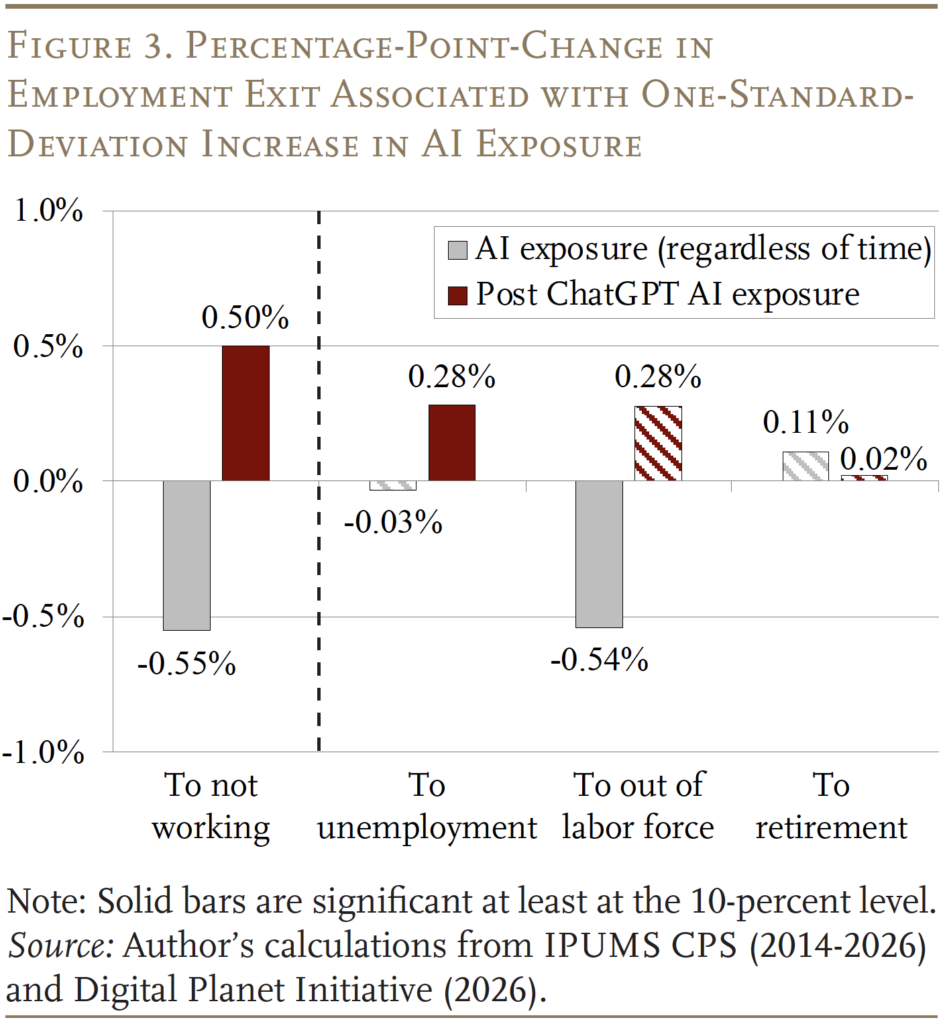
Figure 4 attempts to put this result into context by showing how the model’s predicted transitions to out-of-work status change for workers in six jobs ranging from low to high in AI exposure. These predictions are formed using the average characteristics for workers in that job (e.g., race, education, marital status, earnings, etc.) and for an average economic period between 2014 and 2025. The predicted change in exit from work reflects only that associated with AI exposure and does not reflect, for example, increases in education, pay, or economic conditions that could affect transitions out of work relative to the pre-period.
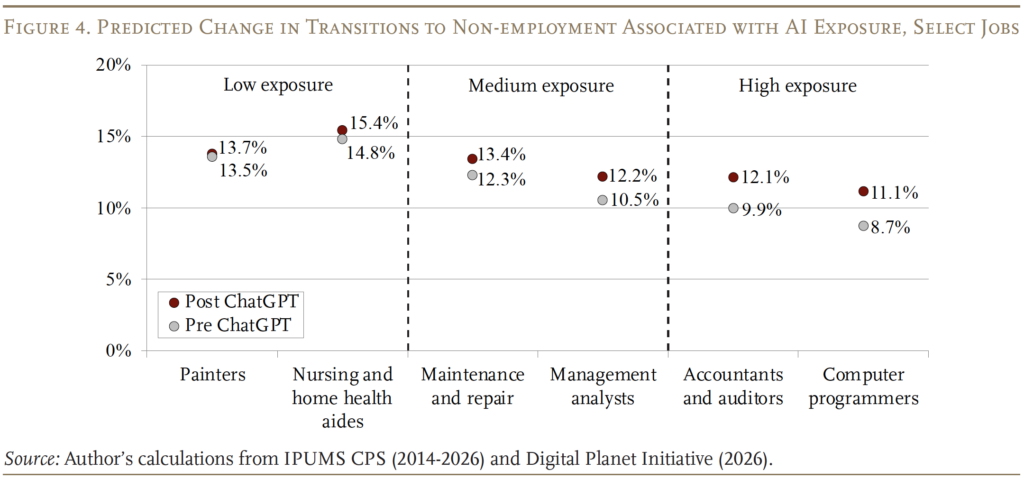
The figure makes it clear that some jobs could see relatively large increases in transitions out of work, while others are mostly unaffected. For example, painters – with the lowest exposure score here – see just a 2-percent increase ((13.7-13.5)/13.5). For computer programmers – on the other end of the spectrum – the increase is over 25 percent ((11.1-8.7)/8.7). And, unlike other recent types of automation, the impact of AI might be the biggest in higher-paying jobs (again, programmers vs. painters). Still, the figure suggests that jobs associated with longer careers before ChatGPT will not go away. After all, the more exposed jobs in Figure 4 still have lower transitions out of work than the less exposed jobs even after the predicted increases. This finding is likely due to their higher educational requirements and correspondingly lower physicality and higher pay. But, AI exposure may reduce the gap in career length between low- and high-paying jobs.
Conclusion
The analysis here suggests that older workers in jobs with greater exposure to AI have seen relatively large increases in job exit since the launch of ChatGPT. Like any early analysis of the impact of AI, caution is in order. For example, if government R&D cuts under the Trump Administration have hit AI-exposed jobs especially hard, it could exaggerate the estimated impact of the AI explosion. Or, if the wave of AI start-ups is currently leading to rapid growth in AI-exposed jobs (like data scientists), the results here could understate what will happen when that growth stops or those jobs are themselves replaced by the AI being developed.
Still, the analysis suggests that the issue of AI-exposed jobs and older workers is worth keeping an eye on. The significant increase in exit from work threatens older workers in exposed jobs with shorter careers if they cannot find new work.19 As policymakers consider changes to Social Security that could necessitate longer careers, they should be aware that this new technology could be pushing some workers in the other direction.
References
Acemoglu, Daron and Pascual Restrepo. 2019. “Artificial Intelligence, Automation, and Work.” In The Economics of Artificial Intelligence: An Agenda, edited by Ajay Agrawal, Joshua Gans, and Avi Goldfarb, 197-236. Chicago, IL: University of Chicago Press.
Bessen, James E. 2016. “How Computer Automation Affects Occupations: Technology, Jobs, and Skills.” Law and Economics Research Paper. Boston, MA: Boston University School of Law.
Bick, Alexander, Adam Blandin, and David J. Deming. 2025. “The Rapid Adoption of Generative AI.” Working Paper 32966. Cambridge, MA: National Bureau of Economic Research.
Briggs, Amanda, Barbara Butrica, and Hailey D’Elia. 2026. “AI and Older Workers.” Washington, DC: The Urban Institute.
Brynjolfsson, Erik and Tom Mitchell. 2017. “What Can Machine Learning Do? Workforce Implications.” Science 358(6370): 1530-1534.
Chow, Andrew R. 2026. “Everyone’s a Line On a Spreadsheet:’ Inside Oracle’s Mass Layoffs and the Workers Fighting Back.” (May 1). New York, NY: Time.
Digital Planet Initiative. 2026. “Will Wired Belts Become the New Rust Belts: AI and the Emerging Geography of American Job Risk.” Medford, MA: Tufts University Fletcher School.
Ember, Sydney. 2026. “Graduates Reset Ambitions in Pursuit of First Jobs.” (April 28). New York, NY: The New York Times.
Eloundou, Tyna, Sam Manning, Pamela Mishkin, and Daniel Rock. 2024. “GPTs are GPTs: Labor Market Impact Potential of LLMs.” Science 384(6702): 1306-1308.
Felten, Edward, Manav Raj, and Robert Seamans. 2021. “Occupational, Industry, and Geographic Exposure to Artificial Intelligence: A Novel Dataset and Its Potential Uses.” Strategic Management Journal 42(12): 2195-2217.
Friedberg, Leora. 2003. “The Impact of Technological Change on Older Workers: Evidence from Data on Computer Use.” ILR Review 56(3): 511-529.
Hudomiet, Péter and Robert J. Willis. 2022. “Computerization, Obsolescence and the Length of Working Life.” Labour Economics 77: 102005.
Korst, Jeremy, Stefano Puntoni, and Mary Purk. 2024. “Growing Up: Navigating Gen AI’s Early Years.” Philadelphia, PA: AI at Wharton and GBK Collective.
IPUMS USA. 2026. IPUMS CPS: Version 12.0 [dataset]. Minneapolis, MN: University of Minnesota.
O*NET OnLine, National Center for O*NET Development. 2026. “Editor.”
Munnell, Alicia H., Matthew S. Rutledge, and Geoffrey T. Sanzenbacher. 2019. “Retiring Earlier than Planned: What Matters Most?” Issue in Brief 19-3. Chestnut Hill, MA: Center for Retirement Research at Boston College.
Perron, Rebecca. 2025. “How AI is Impacting the Future of Work Among Adults Age 50-Plus.” Washington, DC: AARP Research.
Weber, Lauren and Ray A. Smith. 2026. “Workers Opt to Retire Amid Shift to AI.” (April 7). New York, NY: The Wall Street Journal.
Appendix
Endnotes
- Ember (2026). ↩︎
- See Chow (2026) or Weber and Smith (2026) for examples. ↩︎
- For an excellent discussion that informs this paragraph, see Acemoglu and Restrepo (2019). ↩︎
- See the O*NET Online summary for “Editor.” ↩︎
- Acemoglu and Restrepo (2019) cite work by Bessen (2016) explaining how ATMs made tasks formerly done by tellers so cheap that more bank branches were opened, expanding demand for tellers who could handle non-automated tasks. ↩︎
- See Briggs, Butrica, and D’Elia (2026) for a discussion of the potential for age bias. ↩︎
- See Hudomiet and Willis (2022) for work suggesting that pressure to adopt the computer may have led to early retirement for some workers. ↩︎
- See Friedberg (2003) for a study that suggests that computers made it more attractive to keep working for people who used them frequently. ↩︎
- Bick, Blandin, and Deming (2025). ↩︎
- Korst, Puntoni, and Purk (2024). ↩︎
- Perron (2025). ↩︎
- These weights are constructed using Principal Component Analysis, which is often used to combine different measures into a common index. ↩︎
- This measure comes from Eloundou et al. (2024) et al., who defined tasks using the Detailed Work Activities from the O*NET 29.2 database. Digital Planet used the average of the human and ChatGPT-4 estimates as inputs to their exposure score. ↩︎
- This measure comes from Brynjolfsson, Mitchell, and Rock (2017), who also use the O*NET and Detailed Work Activities to define tasks within occupations. Their complete rubric has 21 points. ↩︎
- This measure comes from Felten, Raj, and Seamans (2021), who use the 52 abilities defined by O*NET associated with occupational workplace activities. ↩︎
- It’s worth noting that while the Digital Planet exposure data use Standard Occupational Classification (SOC) codes from the U.S. Bureau of Labor Statistics, the CPS uses Census occupational codes. Crosswalks are readily available to merge across the coding systems, although the matching isn’t perfect – often the Census codes are less specific. For example, in the SOC occupational codes, loan officers and credit counselors are listed separately whereas in the Census codes they are combined into a single occupation. In these cases, a weighted average of the exposure scores for the two separate occupations are used in the analysis, with the weights being the number of people employed in the SOC occupation. Such imperfect matching could cause the analysis to understate the impact of AI exposure. ↩︎
- The analysis excludes workers first observed in December 2021 through November 2022, as the year in between the first and second observations includes both time before and after ChatGPT’s launch. ↩︎
- Since Probit regressions are non-linear, this marginal effect is calculated at the mean exposure of 54 and increasing exposure by 18, which is one standard deviation. The “to unemployment” and “to out of labor force” bars do not add up to the “to not working” bar due to the non-linear nature of Probit marginal effects. ↩︎
- See Munnell, Rutledge, and Sanzenbacher (2019) for evidence that, in fact, involuntary job separation often does lead to early retirement. ↩︎



Sanzenbacher, Geoffrey T.. 2026. "Are the Careers of Older Workers Being Cut Short by AI?" Issue in Brief 26-13. Chestnut Hill, MA: Center for Retirement Research at Boston College.