



Nearly Half of Adults Under 30 Live with Their Parents. The Financial Fallout Could Last for Decades.






Geoffrey T. Sanzenbacher is a columnist for MarketWatch and a professor of the practice of economics at Boston College. He is also a research fellow at the Center for Retirement Research at Boston College.
Childhood homes are the new “first apartment.”
Millennials came of age watching shows like “Friends” and “New Girl” that often featured 20- and 30-somethings living in their first apartments. The characters’ parents may visit and participate in the story lines, but the young adults are living independently.
It doesn’t seem a coincidence to me that a newer show that caters to Gen Z, “Adults,” has a group of friends living rent-free in one of the character’s childhood homes. Call it fiction following fact.
The reality is that 25-34-year-olds are increasingly living with their parents. In 2025, 49% of adults under 30 lived with a parent, up 12 percentage points from 2019, according to the Federal Reserve’s Economic Well-Being of U.S. Households survey published earlier this year. The reasons aren’t necessarily surprising: the jump comes as students graduate college with high education debt into a weak entry-level job market, and Americans of all ages are struggling with the cost of housing.
Figure 1 highlights how the share of young adult women and men living with their parents has evolved over the last 30 years. It shows large increases for both genders, with men continuing to be the more likely group to be residing in their parents’ homes.
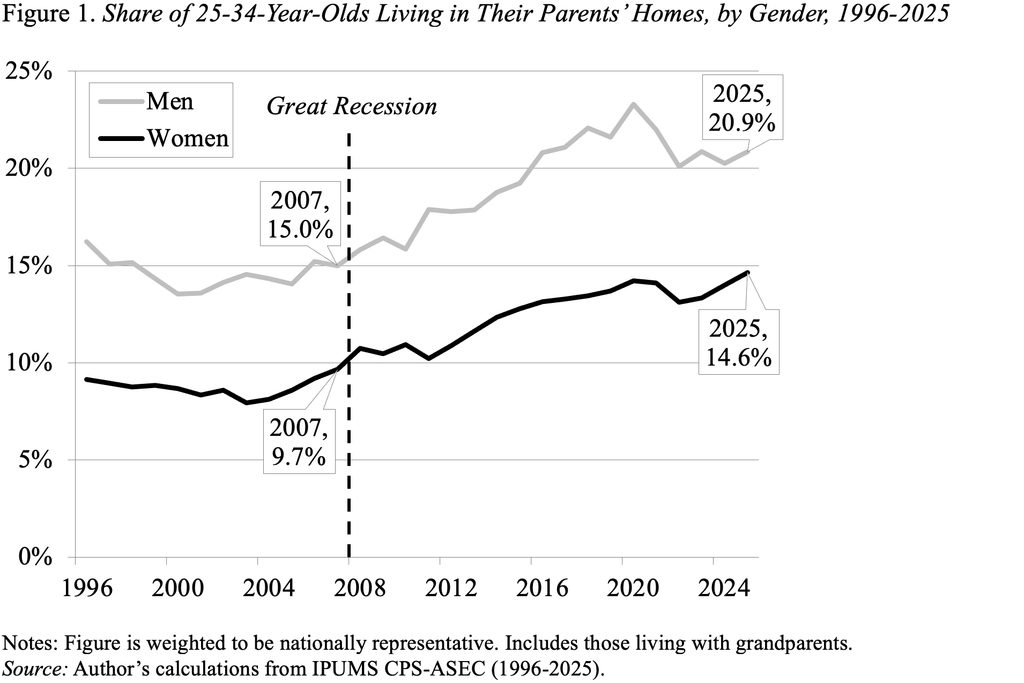
Understanding these increases is important. For one thing, young people who live with their parents are less likely to be married and they accumulate less wealth, especially housing wealth. If that doesn’t worry you, this should: They are also less likely to have children, which could place further strain on programs like Social Security.
A recent issue brief I wrote for the Center for Retirement Research at Boston College explored what role economic changes wrought by the Great Recession might have had in driving growth in young adults living in their parents’ homes.
At first, it seemed odd to me that the Great Recession could trigger such an increase in young adults remaining in their parents’ home. While it caused an over two-fold increase in unemployment among those ages 25 to 34, by 2016 things were back to normal. And while real wages initially dropped, they too are back in positive territory, especially for women. If work and wages look similar to before the Great Recession, why wouldn’t the rate of parental co-residence go back to normal too?
What hasn’t returned to pre-Great Recession levels are housing markets. To illustrate, Figure 2 shows how Fair Market Rents (a measure of rental rates used by the Department of Housing and Urban Development), the Consumer Price Index (CPI), and rental vacancy rates have evolved since 2007. Rents have grown faster than inflation and the vacancy rate has fallen by 30 percent. It turns out, the Great Recession did some long-lasting damage to the rental housing market.
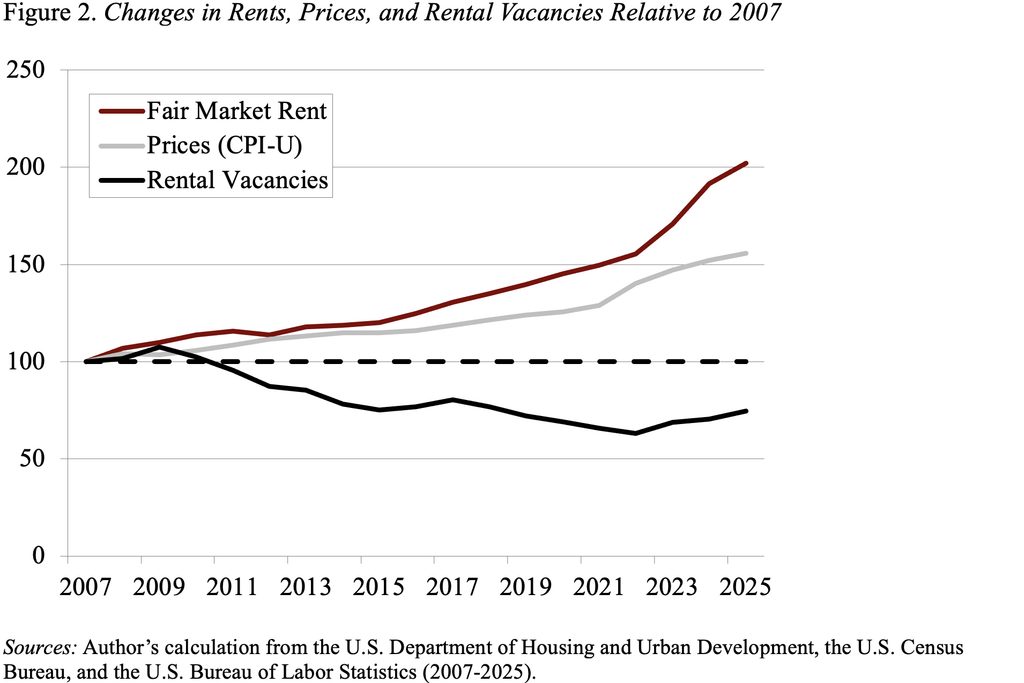
Do these tough rental markets explain the increase in young adults living with their parents? The CRR brief found that it could…at least partially. The approach was simple. It did a statistical analysis to see if otherwise similar people – in terms of education, race, etc. – had different rates of parental living based on the rental market of their state of residence. It turns out that people in states with higher real rents and lower vacancies were significantly more likely to live with their parents. This relationship existed for both women and men.
With estimates of the relationship in hand, the brief then asked how the rate of living with one’s parents would be if 2007 economic conditions existed today. While the brief looked at a variety of economic outcomes – including employment, wages, and general inflation – looking at rental conditions alone can help isolate how housing markets spillover into people’s everyday lives. It turns out that if 2007 rental conditions prevailed today, parental living would be 1.5 percent lower for women and 2.1 percent lower for men. While this decline is hardly trivial, it’s worth noting that in 2007 the actual rates were 4.9 and 5.9 percentage points lower for women and men respectively. So, other factors than rental markets seem to be playing a role too.
Determining these factors was mostly beyond the scope of my brief, but it never hurts to speculate just a bit.
One possibility is that the rise in these living arrangements is just a side effect of another jarring trend – rapidly declining marriage and fertility rates. If not married with kids, living with parents could be a decent option. The problem is that these trends are not very well understood either. Or, it could be the explosion of digital technologies that gives today’s young adults alternatives to in-person relationships. The other possibility is that the rise in living with parents is somehow a cause, not a side effect, of declining marriage and fertility. For example, perhaps increased closeness to parents facilitated by smartphones or gentler parenting styles leads young adults in their 20s and early 30s to be more comfortable living with their folks. More research is needed.
Finding other causes is important, since fixing housing markets can only get us part of the way there. While the trope of young adults living with their parents is often played for laughs – I still remember the movie “Failure to Launch” – the consequences are real. For the individual, less wealth. For society, fewer new families.
As the first members of Gen Z hit 30, this topic merits attention.