


Social Security’s Biggest Problem Isn’t a Design Flaw. It’s a Missing Trust Fund.






Alicia H. Munnell is a columnist for MarketWatch and senior advisor of the Center for Retirement Research at Boston College.
Should policymakers look beyond the payroll tax to cover this share of the deficit?
When thinking about how to fix Social Security, it is important to understand the reasons for the shortfall. If current benefits simply cost more than what today’s workers are paying, then the right action is to reduce benefits or raise payroll taxes.
However, the cost of the shortfall lies elsewhere: the Missing Trust Fund.
If Social Security were financed as a funded 401(k), it would require a combined employer-employee contribution of 11.7 percent of earnings to duplicate Social Security’s benefits at age 65 for the average earner (see Figure 1). Interestingly, this required contribution is very close to the 10.6-percent tax that employees and employers currently pay for Social Security retirement benefits.
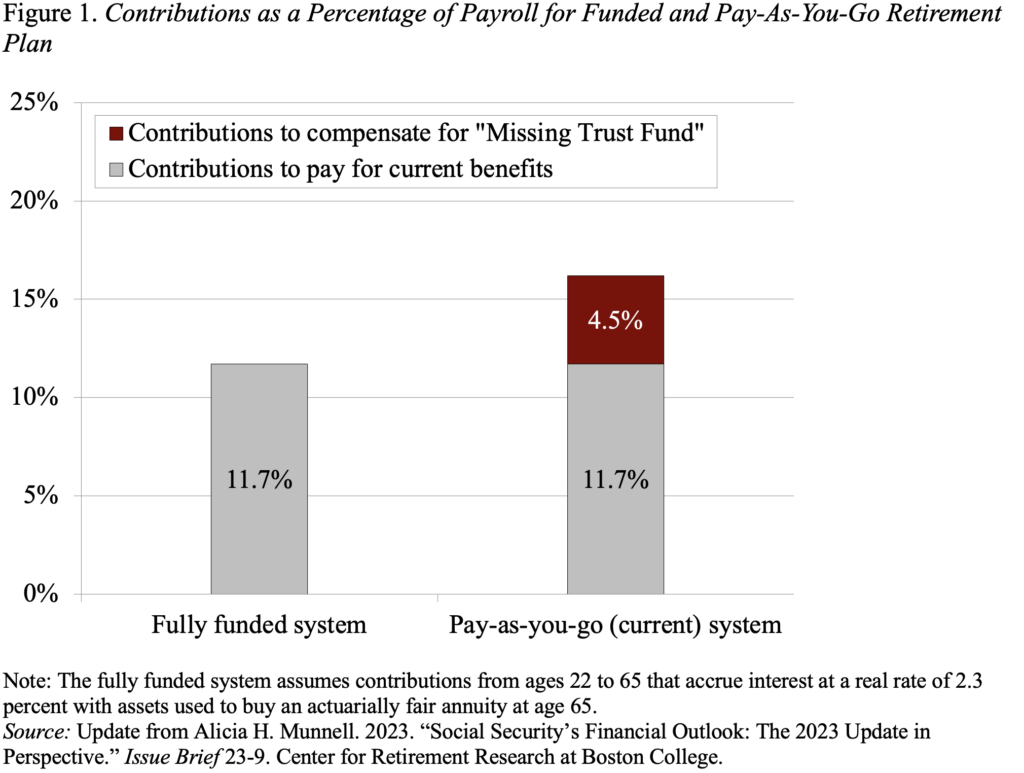
But Social Security is not financed like a 401(k) plan. Instead, it operates on a pay-as-you-go basis. That is, Social Security contributions are not invested in a fund but rather used to pay benefits to current retirees. As a result, the payroll tax must cover not only the 401(k)-type contribution but also the returns that could have been generated by investing those contributions in a trust fund. The cost of this Missing Trust Fund is the difference between the cost of operating Social Security on a pay-as-you-go basis rather than as a funded program, and that cost, as shown in Figure 1, amounts to 4.5 percent of taxable payroll.
This pay-as-you-go approach is the result of legislation in 1939 that tied benefits to average earnings over a minimum period of coverage, and that rewarded early generations with windfall returns on their contributions. While this decision is understandable, given that many of the early beneficiaries had fought in World War I and endured the Great Depression, it did not come for free. As noted, payroll taxes today and in the future must cover not only the required 401(k)-type contribution but also the missing interest. As a result, roughly 60 percent of the gap between payroll taxes and program costs is attributable to the Missing Trust Fund (see Figure 2).
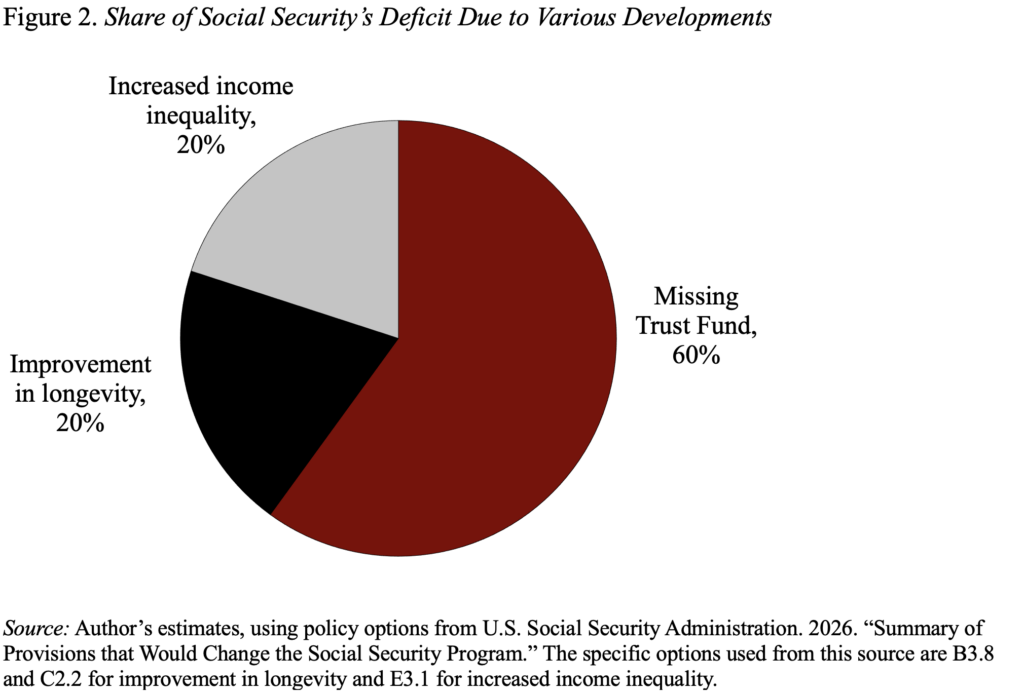
The other factors contributing to the shortfall are longer lives and increased earnings inequality. Here, the answers are relatively easy. Most of the improvement in life expectancy has been enjoyed by higher earners and can be addressed by some benefit cuts aimed at this group. The main impact of increasing inequality is that a greater share of earnings falls above the current maximum on taxable earnings ($184,500). The obvious adjustment is to increase the maximum to cover about 90 percent of earnings, as envisioned in the 1983 legislation.
How to address the share of the shortfall created by the Missing Trust Fund is a bigger challenge. There is no way to get back the money given to early retirees; the only questions are how to spread out the burden over time and how to finance this share of the shortfall. In terms of allocating over time, an equitable plan would probably aim to keep the burden associated with the Missing Trust Fund steady across generations. Someone smarter than me can do that calculation.
In terms of financing, is it fair to ask today’s workers to pay higher taxes because of the historical decision to give away the trust fund? This decision benefited all our parents and grandparents. One could argue that the burden should be shared more broadly than through a regressive tax on today’s workers.
Even though I think that Social Security must be financed by a dedicated tax to protect the program from the political uncertainty associated with annual appropriations, the shortfall due to the Missing Trust Fund seems like a different animal.
I have often thought this component should be paid by the more progressive federal income tax. Now, I think the place to look for revenues is taxing wealth. If we had a meaningful estate tax, that would be an obvious option. But we don’t. Perhaps, the answer could be some combination of taxing gains at death and taxing inheritances under the federal income tax, as recently advocated by my colleague Ray Madoff.
In any case, the high cost of Social Security does not reflect a flaw in the program’s design; it is primarily due to a decision many decades ago to pay full benefits to early retirees.
We need to figure out how to deal with the fallout from that decision.