

How Do People Feel About Robot Caregivers? Evidence from Japan


The brief’s key findings are:
- Due to staff shortages in nursing homes, Japan has been at the forefront of experimenting with robots and assistive technologies.
- To gauge public support for these robotic aids deployed in nursing homes, a new study surveyed older Japanese adults who are not in nursing homes.
- The findings show strong support for the three types tested: mobility-aid robots, communication robots, and monitoring sensors.
- Strikingly, respondents are also willing to pay more for a facility that uses robots.
- These results could be instructive for the United States, but the degree to which older Americans would welcome robot caregivers is an open question.
Introduction
As populations age, a growing number of people need long-term care, such as help with basic daily activities such as eating, bathing, and mobility. While most people prefer to receive care at home, many older individuals with extensive care needs will spend at least some time in a nursing home. In many developed countries, the demand for such care is already outpacing its supply.1 A key constraint is the shortage of caregivers, a problem that is projected to intensify when baby boomers begin to reach their mid-80s.2
One potential response is to use caregiving robots and information & communication technology (ICT) – such as sensors for monitoring vital signs – to perform some of the tasks currently done by human caregivers. Japan has been at the forefront of this approach. In 2015, the Japanese government began subsidizing nursing homes’ purchases of caregiving robots and ICT, and by 2022, more than 70 percent of Japanese nursing homes used at least one caregiving robot.3 Yet little large-scale evidence exists on whether older individuals, the future users of such care, actually want it. This evidence is crucial for judging whether robots and ICT are a useful response to the caregiver shortage.
This brief, adapted from a recent study, provides large-scale evidence on older Japanese individuals’ preferences for care provided with robots and ICT, based on a new survey.4 Beyond asking whether respondents would accept such care, the survey elicits how much they would be willing to pay for it. This measure makes it possible to compare the perceived benefits of robots and ICT with their estimated costs.
The discussion proceeds as follows. The first section describes three common types of caregiving robots and ICT. The second section describes the survey. The third section shows that about two-thirds of respondents prefer a nursing home that uses robots and ICT over one where all care is provided by humans. On average, they are also willing to pay 8 percent more than the typical nursing home fee in Japan for such a facility. Both acceptance and willingness to pay are highest for mobility-aid robots and lowest for communication robots. The fourth section compares these perceived benefits with rough estimates of the costs, which suggests that the benefits are likely much larger, especially for mobility-aid robots. The final section concludes that robots and ICT appear to be a feasible approach for easing caregiver shortages in Japan, while future research could explore the extent to which these findings apply to the United States and other countries.
Caregiving Robots and ICT: Three Common Types
Caregiving robots and ICT come in many forms.5 Our research focuses on three common types used in Japanese nursing homes: 1) communication; 2) mobility-aid; and 3) monitoring robots and ICT.6 For simplicity, the rest of this brief refers to all three as “robots.”
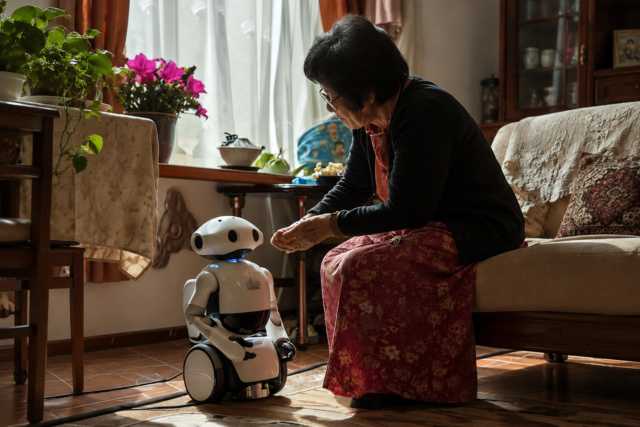
Communication robots typically take the form of robotic pets, small robotic characters, or humanoids. Their main function is to converse with residents to improve their mood and reduce feelings of isolation. Many can also remind residents to take medication or do stretching exercises, and share information from their conversations with caregivers and family members. Because robots do not tire from repetitive interactions, they can provide a reliable source of social engagement for residents.
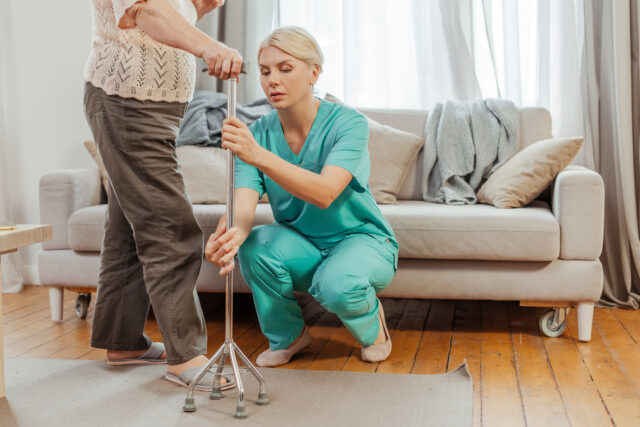
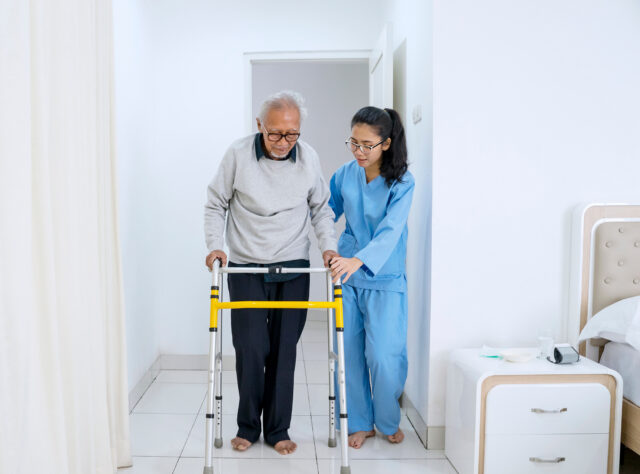
Mobility-aid robots come in several varieties, and – in appearance – they are typically more like machines rather than humanoids. The analysis here focuses on mobility aids that lift residents for transfers between beds, wheelchairs, and toilets. Lifting a resident by hand is physically demanding, and it can injure residents where pressure is concentrated, such as under the arms. With a lifting robot, a single staff member can complete a transfer without any manual lifting. The resident rests in a wide, soft sling that supports the body and spreads the weight evenly, rather than concentrating it in one area. Easier transfers may also allow residents to be more active and give them more privacy during activities such as bathing, since fewer staff need to be present.
Monitoring robots connect sensors in residents’ rooms and beds to monitors at nursing stations and to devices carried by staff. They continuously track vital signs, relieving staff of manual measurement and recording. Because residents are monitored remotely, staff no longer need to make routine nighttime room checks, which can disrupt residents’ sleep. The systems can also detect when a resident tries to get out of bed, so staff can step in if there is a risk of a fall.
Each type of robot also raises concerns. Communication robots may deprive residents of opportunities for genuine human connection. Mobility-aid robots carry a risk of injury if the equipment malfunctions or is used improperly. And with monitoring robots, if staff visit rooms less often, needs that the sensors fail to detect may go unaddressed.
Data
The results in this brief are from an online survey conducted jointly by Survey Research Center Co., Ltd., a Japanese company, and NTT DOCOMO BUSINESS X, Inc., which maintains one of the largest online survey panels in Japan. The survey was fielded in July and August 2026 to Japanese individuals ages 55-75 who were not receiving long-term care, and it asked about the choices they would make if they needed such care in the future. In total, 4,314 respondents completed the survey. Quota sampling ensured equal numbers of respondents in each five-year age group, equal representation of men and women, and representation across Japan’s prefectures in proportion to their populations. Key survey questions are described, along with the results, in the next section.
Acceptance of Robots
To measure acceptance of robotic care, the survey asked respondents to imagine that they are 85 years old, need significant help with daily activities, and must enter a nursing home. They then choose between two nursing homes that are identical in room type and monthly fee, which is set at 150,000 yen (about $950 USD), the typical fee in Japan.7 The only difference is that one nursing home provides all care through human caregivers, while the other uses robots for a substantial share of care in one area. That area is communication, mobility aid, or monitoring, randomly assigned to each respondent.
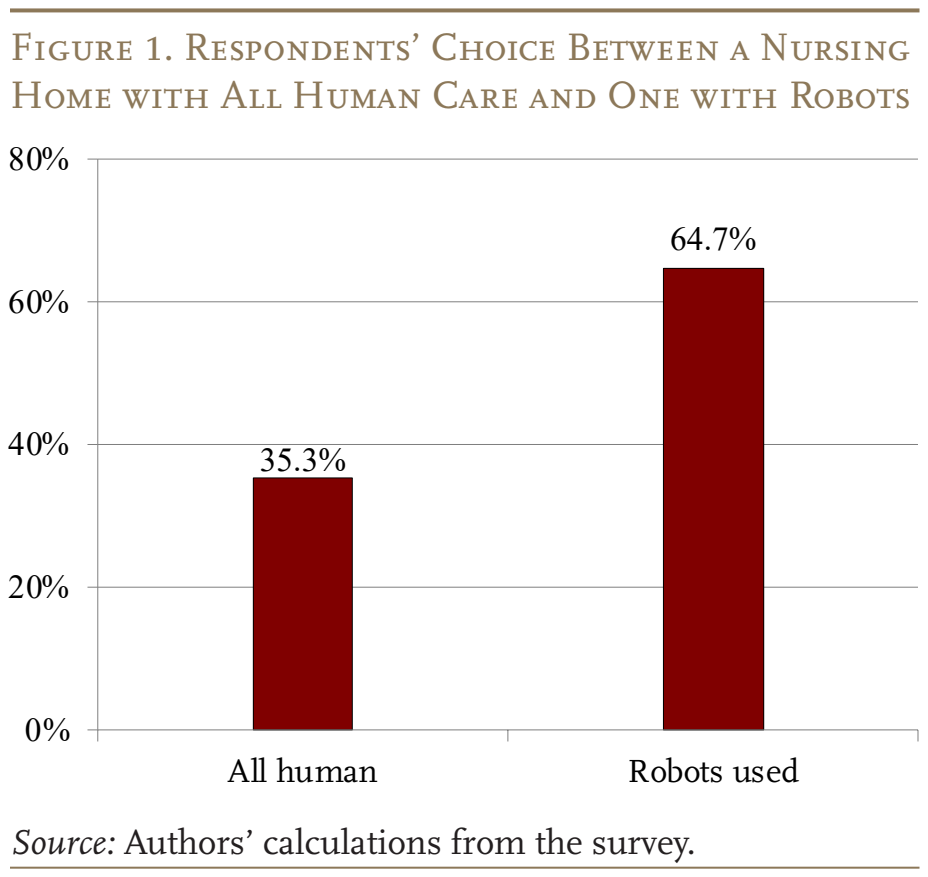
Perhaps surprisingly, a large majority of respondents prefer the nursing home with robots. About two-thirds (65 percent) choose it over the all-human option (see Figure 1).8
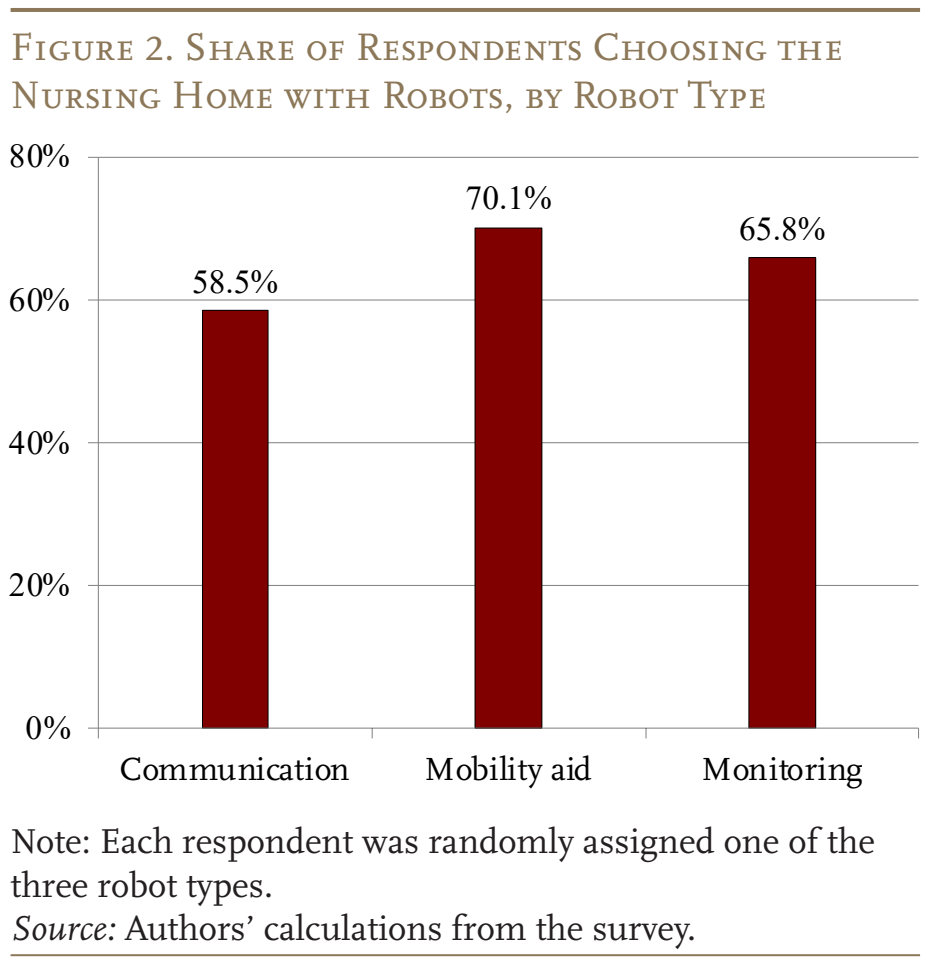
Acceptance varies by the type of robot. Mobility-aid robots are the most welcome: 70 percent of respondents assigned to this type choose the nursing home with robots. Communication robots are the least welcome, at 59 percent, with monitoring robots in between at 66 percent (see Figure 2). These differences are statistically significant at the 95-percent confidence level or higher.
Other survey responses offer some hints about why. In open-ended comments, a few respondents anecdotally noted that mobility-aid robots would relieve caregivers of physically demanding work, freeing them to spend more time talking with residents. Consistent with this view, when asked about their attitudes toward robots in a different section of the survey, respondents were most reluctant to have robots take on communication. Taken together, these responses suggest that older individuals are more comfortable letting robots take on physical tasks rather than tasks that involve human connection.
While clear majorities of respondents prefer robots, the next step is to gauge how strong these preferences are. To this end, the survey follows up on the initial scenario by raising the fee of the nursing home each respondent chose (i.e., robot or all-human) when the two options cost the same, and then asking the question again. The fee at which a respondent switches to the other type of nursing home reveals how much extra they would be willing to pay for their preferred option. This concept, as expressed here, is the willingness to pay for robots, so it is negative for respondents who prefer the all-human nursing home.
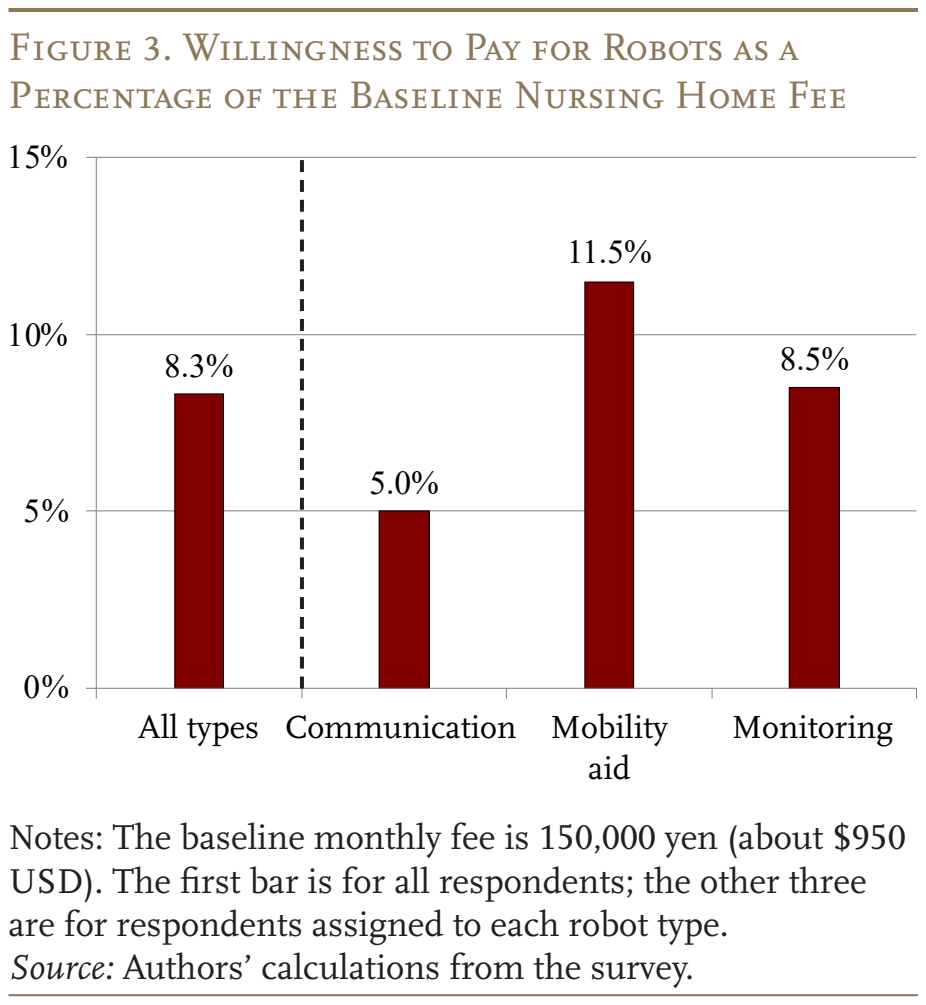
On average, respondents are willing to pay 8.3 percent more than the baseline fee for the nursing home with robots (see Figure 3).9 Willingness to pay follows the same pattern as before. It is highest for mobility-aid robots, at 11.5 percent of the baseline fee, and lowest for communication robots, at 5.0 percent, with monitoring robots in between at 8.5 percent. The gap between mobility-aid and communication robots is statistically significant at the 95-percent confidence level.
Comparison of Perceived Benefits and Costs of Robots
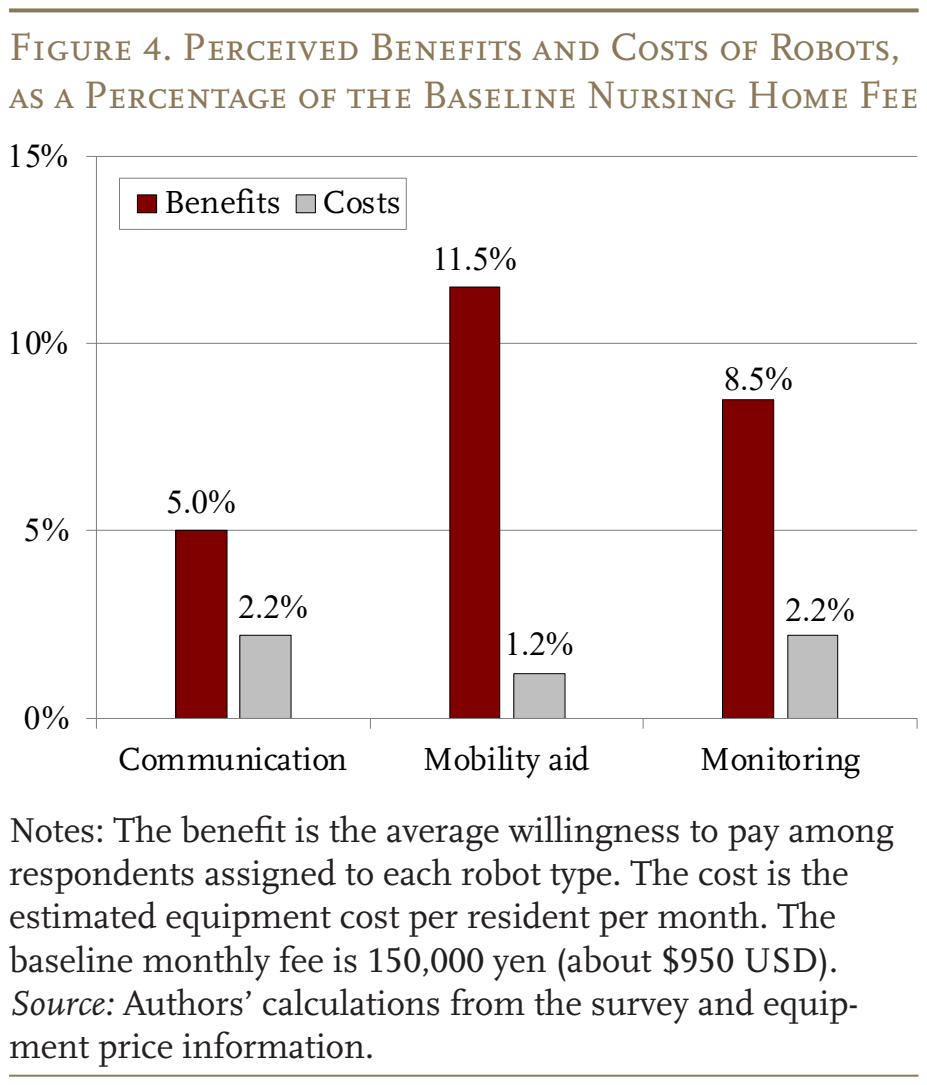
To put these willingness-to-pay figures in perspective, we compare them with rough estimates of what the robots cost. For each type of robot, the perceived benefit is the average willingness to pay of respondents assigned to that type, as shown in Figure 3.
We estimate the cost of each type in three steps.10 First, we start from the purchase price of a representative model of the type, which does not take into account any government subsidies. Second, we divide that price by the typical number of residents who share one unit. Third, we spread it over the equipment’s expected life of five years to obtain a cost per resident per month. We assume that communication and monitoring robots are each shared by two residents in a semi-private room, and that mobility-aid robots are shared by 15 residents. To make the costs directly comparable with the benefits, we express both as a percentage of the baseline nursing home fee.
For all three types, the perceived benefits exceed the costs (see Figure 4). The gap is smallest for communication robots, where the benefit is about 2.3 times the cost. It is largest for mobility-aid robots, where the benefit is almost 10 times the cost.
An important caveat is that these are back-of-the-envelope calculations and should be read as suggestive. The cost estimates cover equipment only. They leave out other costs, such as staff training, maintenance, and changes in how work is organized – but they also leave out possible savings in labor. In addition, the benefit estimates do not capture the value of potentially shorter waits to enter a nursing home if robots expand the supply of nursing home care. Even so, the gap between costs and benefits is large, particularly for mobility-aid robots, suggesting that the perceived benefits likely exceed costs.
Conclusion
Our results suggest that using robots to ease caregiver shortages is a feasible option that accords with the preferences of most potential residents. Specifically, a large majority of respondents prefer a nursing home that uses robots, and on average they are willing to pay a premium for it. Acceptance is far from universal, however: about one-third prefer the all-human alternative. Preferences also differ by type of robot. Mobility-aid robots are the most welcome and command the largest willingness to pay, which makes them the most promising priority for policy support, such as the subsidies Japan has provided since 2015.
These findings cannot be applied directly to the United States. Japan’s culture of not wanting to be a burden on others (“meiwaku”) may make older Japanese individuals particularly receptive to robot care. The availability of foreign care workers, and how well they are integrated into the workforce, also differs across countries. But Japan began facing the pressures of an aging population decades before other developed countries, so its experience could be instructive for the United States, which faces a similar caregiver shortage. Whether older Americans would welcome robot caregivers is an open question that warrants its own study.
References
Achou, Bertrand, Mehdi Ammi, Minchung Hsu, Minjoon Lee, Tomoe Naito, and Keisuke Otsu. 2026. “Would Robot Caregivers Be Welcomed by Older Individuals?” Working Paper #27. Montréal, Canada: HEC Montréal, The Retirement and Savings Institute.
Lee, Yong Suk, Toshiaki Iizuka, and Karen Eggleston. 2025. “Robots and Labor in Nursing Homes.” Labour Economics 92: 102666.
Ministry of Health, Labour and Welfare. 2023. “On the Priority Areas for the Use of Care Technology.” Tokyo, Japan.
OECD. 2020. “Who Cares? Attracting and Retaining Care Workers for the Elderly.” OECD Health Policy Studies. Paris, France.
Scales, Kezia. 2021. “It Is Time to Resolve the Direct Care Workforce Crisis in Long-Term Care.” The Gerontologist 61: 497-504.
Endnotes
- OECD (2020). ↩︎
- Scales (2021). ↩︎
- Lee, Iizuka, and Eggleston (2025). ↩︎
- Achou et al. (2026). ↩︎
- For visual depictions of these different types, see the full paper (Achou et al. 2026). ↩︎
- The descriptions of each type are based on Ministry of Health, Labour and Welfare (2023). ↩︎
- Japan’s public long-term care insurance covers 70 to 90 percent of long-term care costs, so the fee that residents pay is far lower than the full cost of care. ↩︎
- About 70 percent of respondents correctly answered all four questions testing their understanding of the scenario. Acceptance among this group is even higher, at 71 percent, suggesting that the high acceptance is not driven by misunderstanding. ↩︎
- This average includes the negative “willingness to pay” amounts for the one-third of respondents who prefer the all-human nursing home. ↩︎
- In developing these cost estimates, we consulted with experts and practitioners, including the Oita Prefecture Council of Social Welfare. For more details on these estimates, see the full paper (Achou et al. 2026). ↩︎



Achou, Bertrand, Mehdi Ammi, Minchung Hsu, Minjoon Lee, Tomoe Naito, and Keisuke Otsu. 2026. "How Do People Feel About Robot Caregivers? Evidence from Japan" Issue in Brief 26-22. Chestnut Hill, MA: Center for Retirement Research at Boston College.