


Family Caregivers: How Many and Who Are They?





Two recent reports on family caregivers capture the size and nature of caregiving activity. In terms of the number of people caring for adult family members, the reports — the first from the Bureau of Labor Statistics (BLS); and the second from the National Alliance for Caregiving (NAC) and AARP — peg the figure at 38 million and 59 million, respectively. It’s a big range, but the main reasons for the difference are simply that the BLS includes only unpaid family caregivers for older Americans while the NAC and AARP figure covers all family caregivers (unpaid and paid) for adults of all ages.
BLS Results
The BLS finds that, in 2023 and 2024, 14 percent of Americans ages 15+ were providing some form of unpaid care to someone ages 65+. Not surprisingly, the likelihood of providing care increases by age until the caregivers themselves near retirement. And the patterns differ by age as well. For example, younger adult caregivers are more likely to be caring for a grandparent; middle-aged caregivers for a parent; and the oldest caregivers for a spouse. And caregivers ages 55+ spend more time, on average, engaged in caregiving than their younger counterparts: 1-2 hours per day vs. less than an hour.
NAC and AARP Results
NAC and AARP conduct their survey of caregivers every five years. Their Caregiving in the US 2025 finds that 59 million Americans provide care to another adult family member, more than a 40-percent increase over a decade earlier.
About 11 million of these family caregivers are paid; payments are available under Medicaid provisions for home-and-community-based services, which vary by state. It’s worth noting that the vast majority of these paid caregivers also report providing some unpaid care as well.
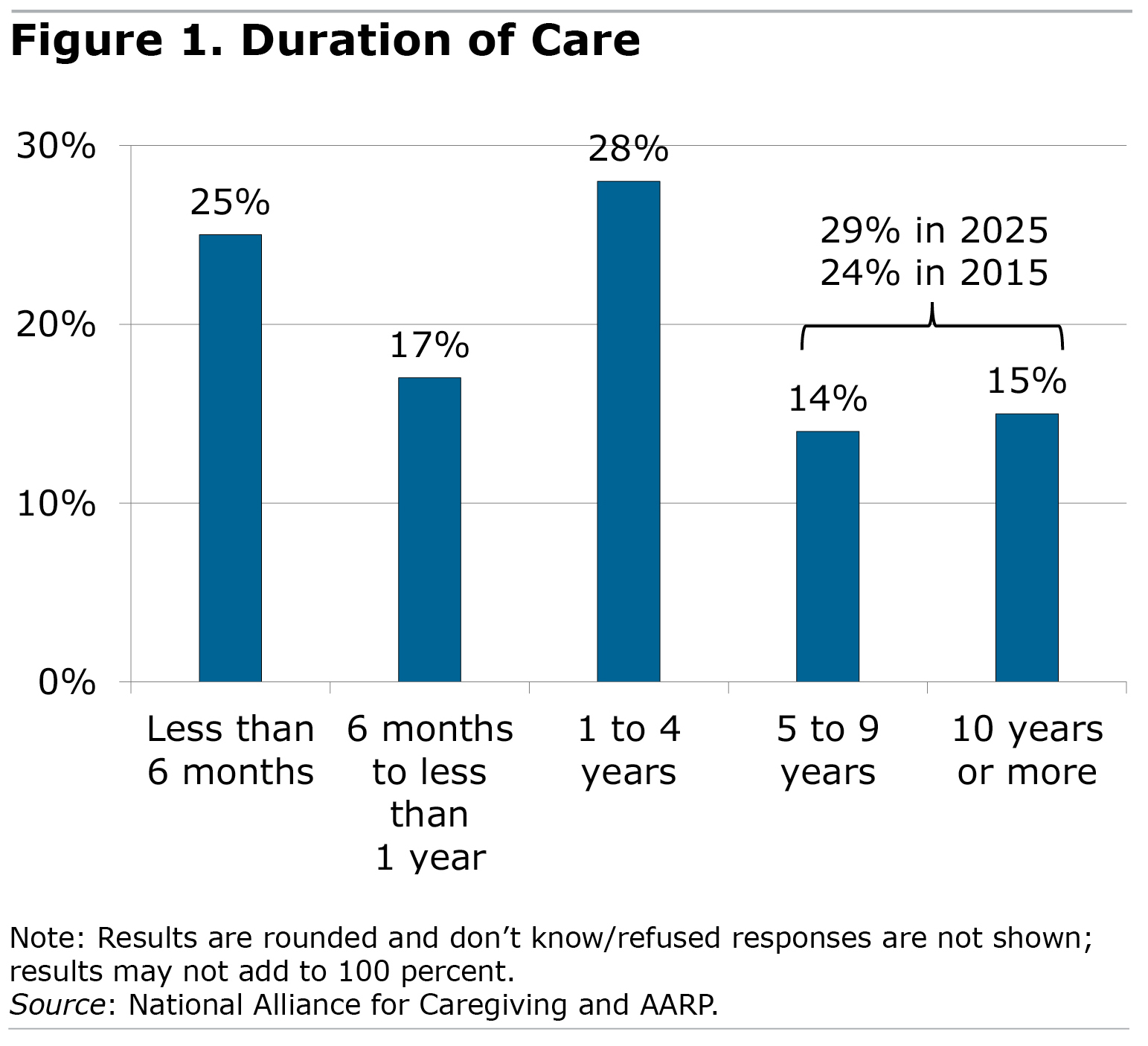
Four in ten caregivers live with their care recipient and about a fifth of them provide 21 or more hours of care a week. A third of family caregivers also have paid assistance. The duration of caregiving ranges considerably with a quarter having provided care for less than half a year and 15 percent for 10 or more years (see Figure 1).
The NAC and AARP survey had some other interesting findings that show that our society appears to be adapting to new technology and to an older population.
For example, the number of family caregivers using some form of remote monitoring device rose from 13 percent in 2020 to 25 percent in 2025. And employers are providing more benefits than was reported in previous surveys, including paid sick days, paid and unpaid family leave, flexible hours, remote work, and other programs to help caregivers.
But it’s still hard to juggle work and caregiving, with 56 percent of employed family caregivers saying they had to go in late, leave early or take time off from work due to their caregiving responsibilities; 18 percent reducing their hours of work; and 16 percent taking a leave of absence.
The bottom line is that family caregiving is the core of elder care and the more family caregivers can be supported, the less stress there will be on the rest of the elder care system.
For more from Harry Margolis, check out his Risking Old Age in America blog and podcast. He also answers consumer estate planning questions at AskHarry.info. To stay current on the Squared Away blog, join our free email list.

Comments are closed.

The U.S. does a very poor job caring for its most vulnerable citizens. Medicare does not provide for any long-term care and Medicaid assistance comes after you spend yourself down to poverty. Most elders would prefer to age in place in their own homes but home health and personal care aides are often not available or affordable. While the cost averages $34/hour, only half of that goes to the aides; the rest goes to the agencies that vet them and act as intermediaries. With salaries of $17/hr for demanding work, turnover is huge and the current inhospitable climate for foreign-born workers further decreases the supply.
Improving pay and working conditions for home healthcare workers and providing pay and support for family caregivers must get more government attention.
Thanks for the focus on this issue it is an important growing family issue.
Please update this information periodical based on the growth of services provided and include the cost of public assistance including compensation for caregivers.
We have seen increased activity of third-party providers recently changing the equation from compensating caregivers directly to funneling the funds through a third-party. The expansion of third-parties has added risks as we have seen in the recent exposures of public assistance fraud on an institutional level.
Early monitoring of the processes could help to keep our public assistance programs clean and effective.
If we are lucky we will all live to be old enough to need the assistance of family and community.