


Uncertainty Around Social Security, Taxes, and Healthcare Is Bad for Households – and the Economy






Alicia H. Munnell is a columnist for MarketWatch and senior advisor of the Center for Retirement Research at Boston College.
Workers and retirees are anxious when faced with unpredictable policies.
Planning for a secure retirement is a major challenge; the plan must cover all of a person’s remaining years and beyond, taking into account their legacy. Further complicating such planning are possible shifts in the public policy environment: changes to social insurance programs can undermine the foundations of a retirement plan; changes to the tax system can scramble a household’s finances; and a ballooning government debt can increase interest rates and slow the economy.
To be clear, “policy uncertainty” is not about policy change, per se, but rather about the unpredictability of future policy. Even without any change to current policy, for example, a tight and polarized election forces households to consider a wider range of policies than if the election outcome were certain or the policy positions of the candidates were similar.
The academic literature suggests that the effects of policy uncertainty on the economy are broadly negative. In the macroeconomy, uncertainty depresses economic activity, increases stock market volatility, and reduces returns. Similarly, unemployment tends to rise with greater uncertainty, whereas consumption and investment tend to fall. It is also clear that households’ attempts to protect themselves against specific risks, such as a cut in Social Security benefits, can harm them. Individuals are willing to forgo as much as 6 percent of expected benefits to resolve the uncertainty about future benefit levels.
Against this background, in partnership with Jackson National Life Insurance, we asked Greenwald Research to survey 1,443 near-retirees and retirees ages 45-79 with over $100,000 in investable assets. The survey explored both how the participants perceived the nature and severity of the risk regarding Social Security, Medicare, and fiscal policy, and how they might act to hedge the risk.
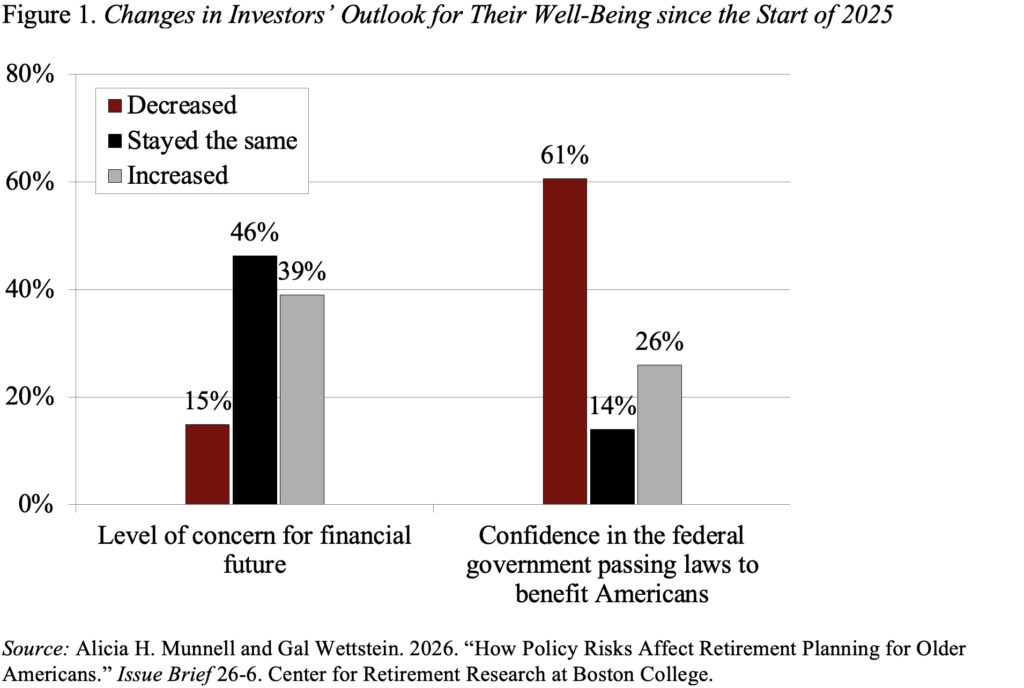
The survey occurred between July 7 and July 31, 2025, a period that now looks almost tranquil compared to the bombing of Iran. But since the beginning of 2025, policy had changed in dramatic ways in terms of taxation – specifically tariffs, the federal debt, and Medicaid (due to the One Big Beautiful Bill Act). And long-term trends in Medicare and Social Security financing had become more concerning. It should therefore come as no surprise that respondents to the investor survey in July 2025 expressed concern about the direction and unpredictability of federal policy (see Figure 1).
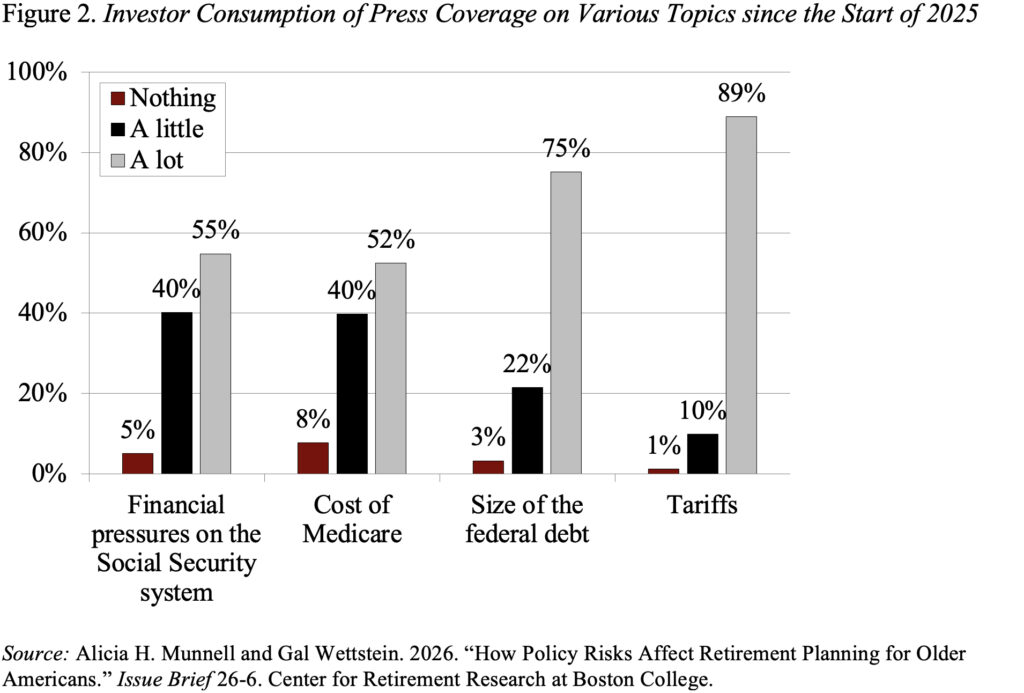
Near-retirees and retirees had also been exposed to a lot of media coverage of policy uncertainty (see Figure 2). Majorities reported having seen stories on Social Security’s financial pressures (55 percent), the cost of Medicare (52 percent), the size of the federal debt (75 percent), and tariffs (89 percent).
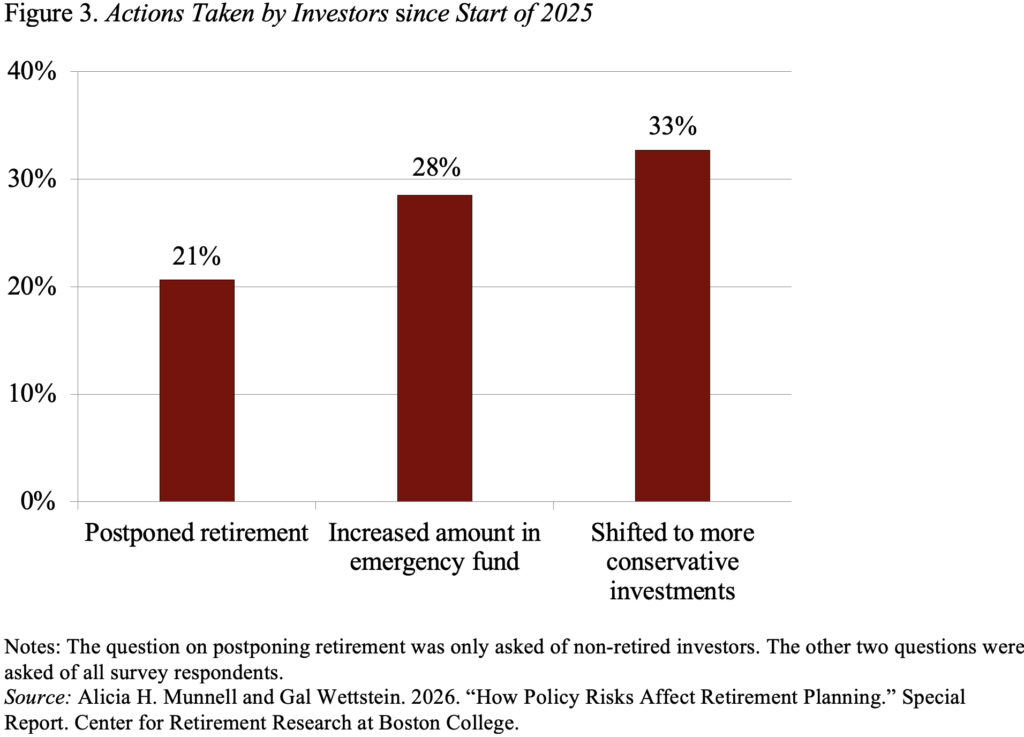
Some more intricate analysis shows a clear relationship between the individual’s consumption of press coverage of Social Security, Medicare, and tariffs/federal debt, on the one hand, and their concern for the future, plans to delay retirement, and move to reduce investment risk, on the other. The net effect is that 21 percent of the unretired respondents in the sample decided to postpone their retirements. And, on the financial side, 28 percent of the entire group increased the amount in their emergency fund, and 33 percent shifted to more conservative investments (see Figure 3).
Overall, the risk that policy uncertainty poses to near-retirees and retirees seems substantial, imposing considerable costs on households as they take precautionary actions, as well as harming the economy. As noted, this survey was undertaken during what now seems to have been a relatively tranquil period in the last 18 months. Clearly, an updated survey would show more anxiety and more individuals planning to take actions to protect themselves. These actions have real costs.