



How Coordinating 401(k) Contributions with Your Spouse Can Unlock Thousands in Retirement Wealth






Geoffrey T. Sanzenbacher is a columnist for MarketWatch and a professor of the practice of economics at Boston College. He is also a research fellow at the Center for Retirement Research at Boston College.
Talking about money can be hard – but in this case, it’s worth it.
There are challenges that come with being in a couple – and just so I don’t anger my wife, I mean financially – but one of the greatest may be simply talking about money.
When it comes to retirement planning, however, communication is key in maximizing households’ 401(k) savings, as a brief by Taha Choukhmane and Cormac O’Dea published by the Center for Retirement Research at Boston College (CRR) reminded me recently.
Defined contribution plans, specifically the 401(k)s, have become the dominant form of retirement plan in the U.S., and employees with access must navigate a variety of choices. For the roughly half of workers whose plans do not automatically enroll them, they must first decide whether to participate or not. Then, participants must decide what to invest in and what share of their salary to contribute.
More than 80 percent of 401(k)-sponsoring employers offer a match that often depends on the employees’ contribution. So, employees must choose a contribution that makes sense for their budget and, to the extent possible, maximizes the match. A famous study showed that individuals often fail in this allocation problem, literally leaving free money on the table.
The CRR brief asked whether couples do the same thing. Could couples increase their retirement wealth simply by shifting a dollar of savings from one person to the other? It turns out, not every couple is taking advantage of this free money. Just over 40 percent couples are actively coordinating their contributions to maximize any additional savings they could get from their matches. And a fifth are leaving money on the table.
How could that be? Could couples increase their retirement wealth simply by shifting a dollar of savings from one person to the other?
Breaking Down Employer Matches
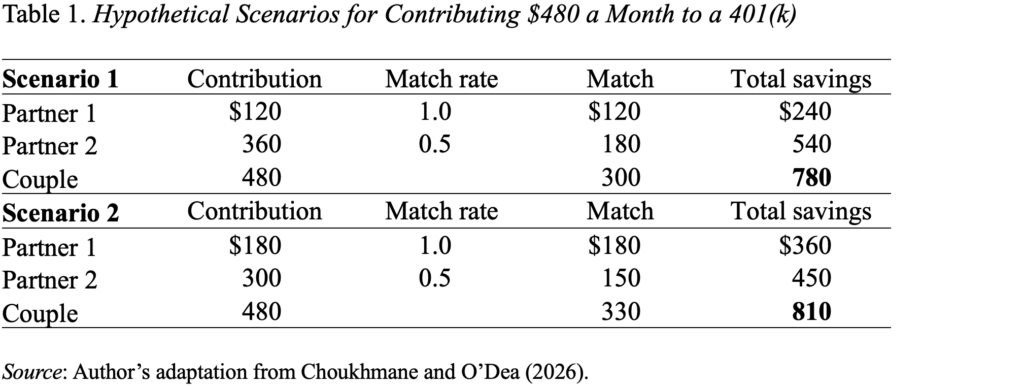
To illustrate how “free” extra savings could happen, the authors of the brief provide an example. Consider a couple where both people earn $6,000 a month. The first partner’s employer matches the initial 3 percent of salary contributed at a 1-to-1 rate. The second partner’s employer also matches the first 6 percent contributed, but instead at a 50-percent rate, or up to a total of 3 percent if the worker contributes at least 6 percent.
Assume that this couple’s budget for retirement saving allows them to save $480 dollars a month. The table below plays out two scenarios that meet this budget: 1) where the first partner contributes 2 percent of their salary and the second partner 6 percent; and 2) where the first partner contributes 3 percent and the second partner 5 percent.
In both scenarios, the couple contributes $480, but in the second scenario they get $30 per month more savings. And while $30 a month may not sound like a lot, a couple saving that extra amount over a 30-year period would end up with roughly $25,000 more in savings in the end (assuming a 5 percent real return). Why all this free money? Simply because the couple took better advantage of the more generous 1-to-1 match by having the first partner save more.
The couples who are not coordinating benefits could have more retirement wealth without actually saving more.
As for the remaining 40 percent of couples surveyed – they don’t appear to be coordinating but they also don’t lose money because of it, perhaps for reasons such as both happening to be maximizing their match. They got lucky.
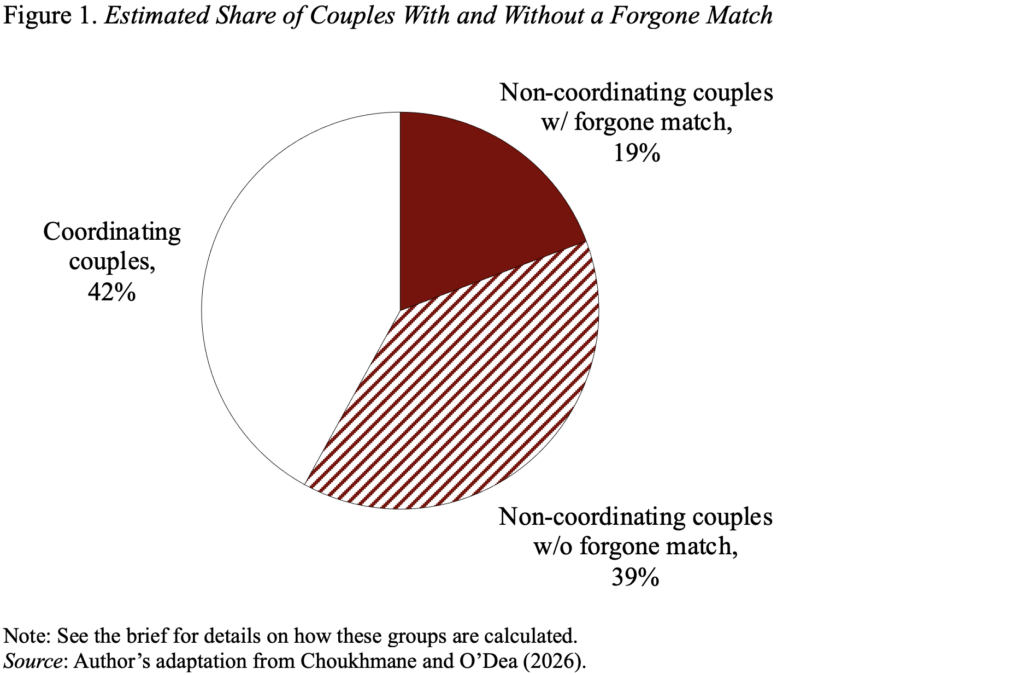
Economists are famous for the saying attributed to Milton Friedman that “there is no such thing as a free lunch.” Figure 1 suggests that for nearly a fifth of couples with 401(k)s, there’s something out there pretty darn close to that fantasy of a costless meal.
These couples can build more retirement wealth by paying one very low “cost”: simply having a conversation about their employer’s 401(k) match and how much each is contributing. I know communication can be hard…but c’mon people. Get talking.