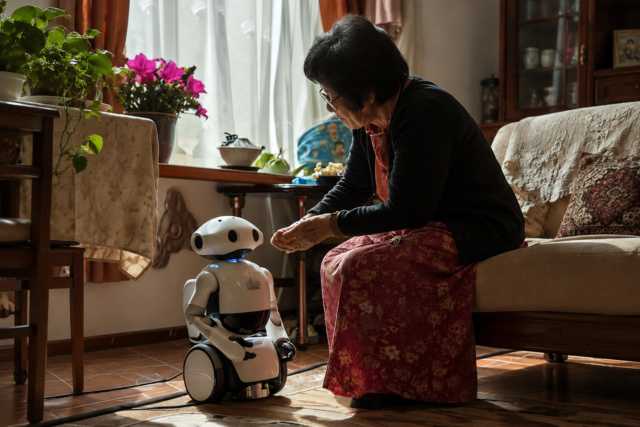



Better Pay and Benefits for Direct Care Workers Could Help Care Recipients and Their Families


In my most recent Risking Old Age in America podcast, I talk with Nicole Jorwic, Chief Program Officer for Caring Across Generations, about the challenges caregivers face, whether they are paid or unpaid. Among other topics, we discuss the conundrum that while paid caregivers are often underpaid, they are too expensive for most families to afford.
Here are some selections from our conversation:
Risking Old Age: Could we start by your introducing Caring Across Generations?
Nicole Jorwic: Caring Across Generations is an organization that works to bring together family caregivers and people who need care, as well as the [direct] care workforce, to build a movement to support care needs all over the country. A big portion of our work and what brought me to Caring Across Generations is our focus on changing the culture and narrative around care and caregiving so that we can get to the policy solutions that we need.
ROA: So, who provides care in the United States?
Jorwic: The vast majority of care is provided by unpaid family caregivers. According to AARP, they contribute $1 trillion to the economy every year. In addition, there’s the direct care workforce, which is made up mostly of women, a high percentage of whom are immigrants, supporting people with disabilities, children, and aging adults.
ROA: What challenges do they face?
Jorwic: For family caregivers, the real need is a system that they can rely on, the infrastructure for which is the paid care workforce.
But unfortunately, this workforce has never been respected with dignity of pay, benefits or other supports. What we need is family-sustaining wages. We need career paths so that people who are providing care can stay in the industry and not need to work three different jobs to make ends meet.
If you have a strong, well-paid workforce, then family caregivers can go back to just being sisters or daughters or friends instead of filling in the gaps in the system.
ROA: Where do you come up with the money to pay them better?
Jorwic: A lot of people don’t realize that Medicaid is the main funder for long-term care. It’s also a workforce program because, for [many] of the people who are providing direct care, Medicaid is the root of their wages. Because we have historically under-invested in Medicaid, the result is those low wages.
We need an understanding of the economic impact on families of not providing this additional funding to support Medicaid. We’re in a really precarious spot right now because there have been cuts to the program and we’re already seeing states making cuts to provider rates, which ultimately means cutting payments for direct care workers.
We had been seeing some really good progress on the workforce because of investments post-COVID, but, unfortunately, we’re seeing all of that slip away, making the situation for both direct care workers and family caregivers even worse.
ROA: Besides paying direct care workers better, what other things can we do to improve conditions for both family caregivers and direct care workers?
Jorwic: We have to make sure that there are strong benefits for direct care workers. These are jobs that can’t be outsourced. They’re very often doing very personal things for people.
This is a workforce for which the need is only growing because of our aging population. In the age of AI, these are jobs that can’t be replaced. So we really need to make sure that there are pipeline programs so that if you’re starting off as a direct care worker, that you have opportunities to do things like getting a degree to become a certified nursing assistant.
More funding can create parity across the systems to elevate the wages for workers. As you mentioned earlier, private pay is not an option for most families because it is so expensive to pay out-of-pocket for care.
ROA: How can we better support family caregivers?
Jorwic: Some of it is recognizing the important role that family caregivers play in the care economy. For example, just this week in Ohio a bunch of folks pushed back against an effort at the state level to remove the ability for family caregivers to be part of the paid care workforce. Keeping the option open for family caregivers to be paid is really important. But supporting family caregivers in the workforce is also really important, because most family caregivers are working other jobs.
It’s also really important for family caregivers who are in the sandwich generation — maybe providing care to kids and older adults — that we’re recognizing that burnout for those caregivers is real. We need to provide flexibility to folks in the workplace, including broad access to paid leave.
We have a business care council at Caring Across Generations, because businesses are seeing the bottom line value in supporting caregivers at work.
So it’s the systems, it’s making sure that we have the care workforce, but it’s also making sure that we’re meeting caregivers where they are, and oftentimes that is at work.

Listen to our entire conversation here.
For more from Harry Margolis, check out his Risking Old Age in America blog and podcast. He also answers consumer estate planning questions at AskHarry.info. To stay current on the Squared Away blog, join our free email list.