



Does Giving Money to Your Parents Make You Less Financially Secure?





The brief’s key findings are:
- Some retirees with insufficient savings rely on their adult children to help, which, in turn, could impact the children’s own retirement saving.
- Perhaps not surprisingly, children who give aid to parents are typically better off financially than non-givers, likely because they can afford it.
- However, Black and Hispanic individuals are an exception: those who support their parents have less retirement wealth and total wealth.
- While they do not appear to save less, their saving could be skewed toward later in their careers, so they miss out on the full benefits of compounding returns.
Introduction
Many households do not have enough saved to maintain their standard of living in retirement. This resource gap means that retirees will often have to cut back on consumption and, in some cases, rely on adult children to help. Children who provide financial support to retired parents may then have to cut back on their own retirement saving, potentially making them less secure when they reach retirement as well. This brief uses the Panel Study of Income Dynamics to examine the extent to which falling short in retirement might have downstream effects on subsequent generations.
The discussion proceeds as follows. The first section provides an overview of existing research on how financial support for family impacts the givers’ own outcomes. The next section describes the data and methods used in the analysis. The third section presents the results and finds that, not surprisingly, parents who are financially strapped in retirement are much more likely to receive transfers from their adult children. At the same time, children who help support their parents are typically better off than their counterparts who do not. The exception, though, is Black and Hispanic givers, who end up with lower retirement savings than their non-giving peers. The reason, however, is not that they contribute less to their retirement accounts overall. Instead, one potential contributing factor is that their savings may be skewed toward later in life, because their parents need help earlier in their lives; as a result, they lose out on years of compounding investment earnings.
The final section concludes that some policies that try to encourage retirement saving could end up backfiring for adult children supporting parents. For example, limiting 401(k) withdrawals may deter such savings for those who need their assets more accessible to support their parents. And raising Social Security’s earliest eligibility age could mean that children need to support their parents longer – because the parents would have to wait longer to claim benefits.
Background
Many households arrive at retirement with insufficient resources to maintain their standard of living – among those with retirement savings, median 401(k)/IRA holdings for working households nearing retirement were only $204,000 in 2022.1 This modest level of resources suggests that many retirees will have to cut consumption and, in some cases, rely on help from children. Such help is more likely to occur within Black and Hispanic families.2 What is unclear is whether children who provide financial support might end up undermining their own retirement security.
While supporting parents will obviously reduce the wealth of adult children, the degree of hardship or impact on retirement security is not obvious. On the one hand, much like parent-to-child bequests, earlier studies have shown that child-to-parent transfers are concentrated among middle- and upper-income households.3 On the other hand, two recent studies found that, even controlling for income, Black and Hispanic workers have lower 401(k) contribution rates and are more likely to take withdrawals.4 While the studies did not examine the reasons for the differences, financial support to parents could be one contributor.
Another possibility is that Black and Hispanic adults transfer money to parents not due to financial need but because of cultural norms or stronger family ties. However, one study shows that the share of Black parents receiving money from children drops after Social Security eligibility, suggesting that transfers are, at least partly, related to financial needs.5 Another recent study shows that transfers to parents were mainly used to pay for bills, rent, medical costs, and insurance.6
This brief explores how providing financial transfers to parents impacts various retirement outcomes for adult children. The results are not only important for understanding intergenerational transfers of wealth but also for the policy implications around retirement plan design and Social Security’s earliest eligibility age.
Data and Methods
The project uses the Panel Study of Income Dynamics (PSID) from 1997-2021 to examine the extent to which parents with insufficient retirement resources might be more likely to receive transfers from adult children and whether those transfers negatively impact the children’s finances. The PSID is the only dataset that includes questions about financial transfers to family members, links parents and children, and follows the parent-child dyads over time.7
The first step is to calculate wealth-to-income (W/I) ratios, a proxy for the level of resources parents have in retirement.8 Using a simple regression, we can examine whether parents with lower ratios are more likely to receive financial transfers from their children:
Probability of transferring $ to parents = f(parent’s W/I, child’s income and wealth, demographics)
Next, we will examine whether adult children compromise their own finances to support their parents. Again, using linear regressions, we can see how transfers to parents impact adult children’s retirement plan participation rates, retirement assets, housing assets, and total wealth:
Child wealth measures = f(amount of support provided, parent’s W/I, child’s income, demographics)
Interacting the amount of support provided with parent wealth/income, child income tercile, and child race/ethnicity can shed light on the multigenerational effects of parents falling short for different socioeconomic groups.
Results
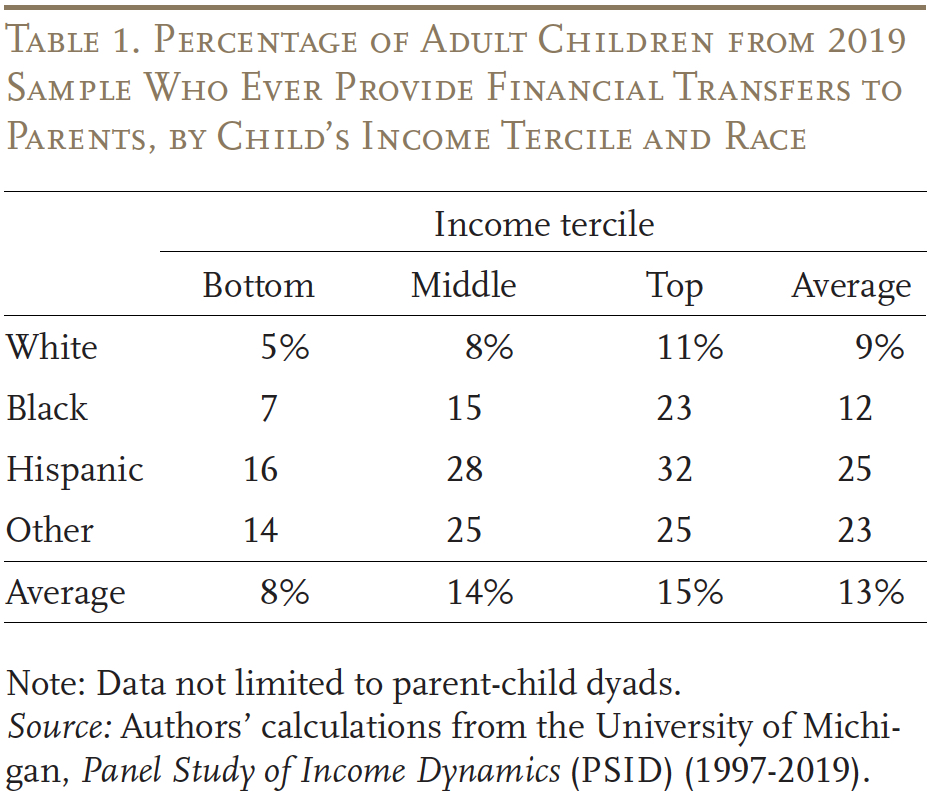
First, it is important to set the stage by determining how common child-to-parent transfers are. Thirteen percent of adult children provide financial assistance to parents who are not living with them. The likelihood increases with the adult child’s income and for non-Whites (see Table 1). For example, almost a quarter of Blacks and about a third of Hispanics in the top income tercile transfer money to their parents.9 A key caveat is that respondents are only asked if they transfer money to someone who is not living with them. The financial support that children might incur if parents end up living with them is not captured. Therefore, Table 1 is a lower-bound estimate of the share of children supporting parents.
What Makes Children More Likely to Give to Parents?
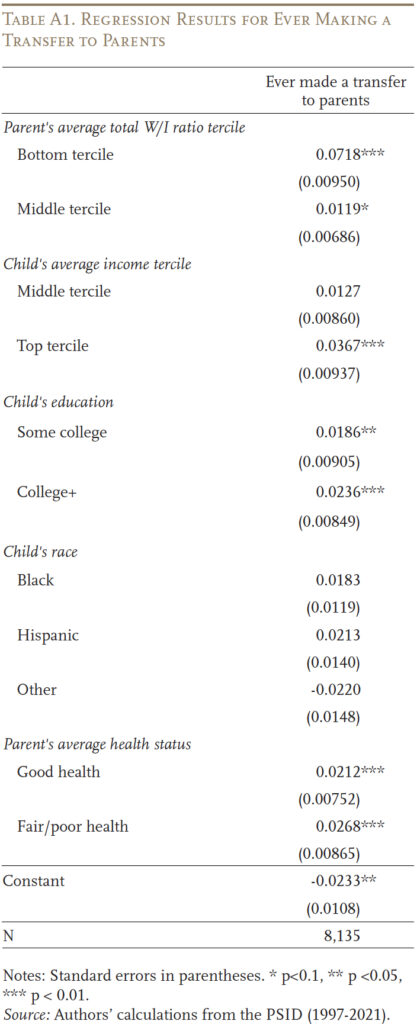
The analysis starts by examining whether adult children are more likely to transfer money to their parents if their parents have fewer financial resources. The results show that children whose parents are at the bottom of the wealth/income distribution are 7 percentage points more likely to provide financial support than their peers whose parents are at the top. This impact is quite large, given that Table 1 showed that 13 percent of children overall support their parents financially. Children whose parents have moderate resources are only 1 percentage point more likely to provide transfers (see Figure 1).10
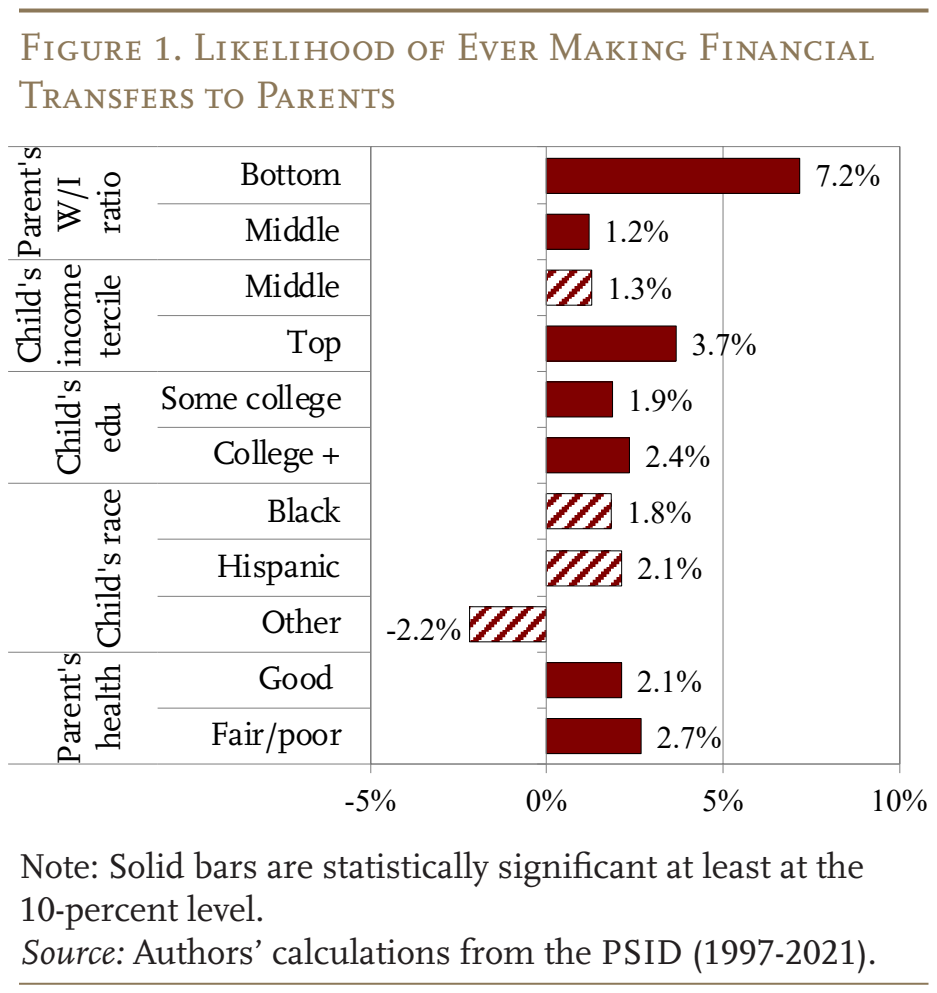
Adult children’s finances are also an important factor in whether they provide financial support, all else equal. For example, adult children in the top income tercile are 4 percentage points more likely to give compared to their peers in the bottom income tercile – likely because they can afford it. Children are also more likely to provide financial support if their parents are in fair/poor health. Interestingly, controlling for all the above-listed factors, Blacks and Hispanics are no more likely to provide financial support than Whites – suggesting that the differences in Table 1 are driven by underlying disparities in financial security across racial/ethnic groups.
The results from Figure 1 clearly show that parents’ retirement preparedness is the biggest predictor of whether their adult children give them financial support. The key question is, how does providing this support impact adult children’s own finances?
How Does Support to Parents Affect Children?
This section provides the results by key characteristics of the parents and children: 1) parents’ retirement preparedness; 2) children’s income; and 3) children’s race/ethnicity.
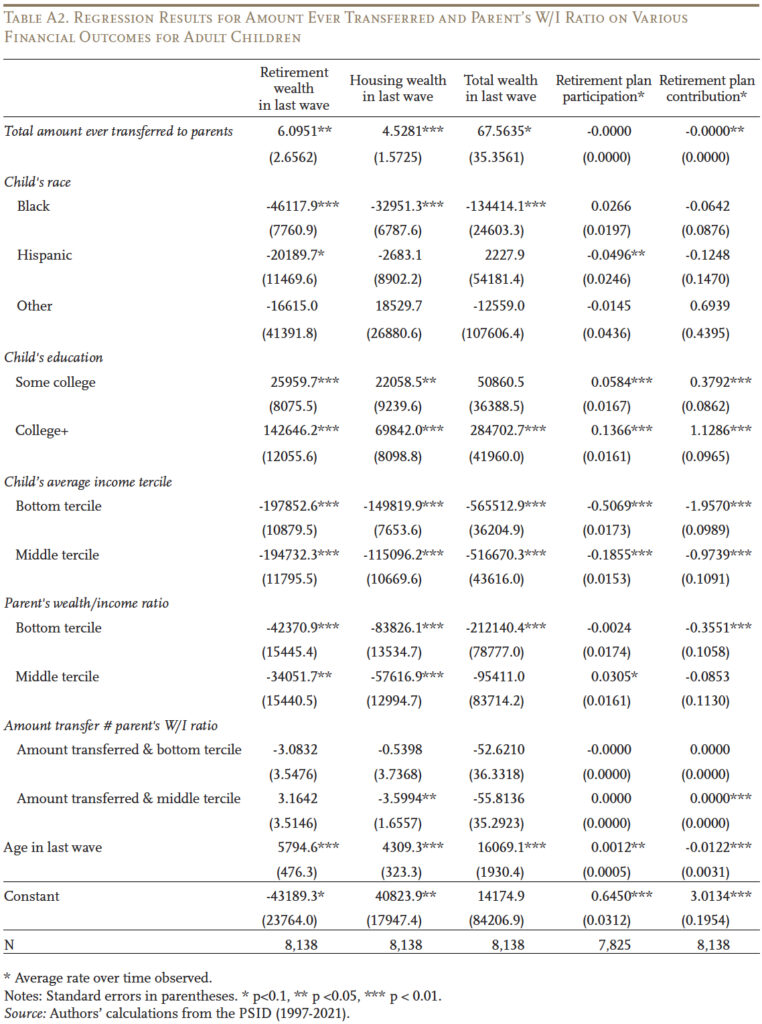
Parent Wealth-to-Income Tercile. When comparing adult children with peers whose parents have similar retirement preparedness, providing parents with financial support does not seem to undermine the adult child’s financial security. In fact, those who provide more for their parents are typically better off than those who give little or no support (see Table 2).11
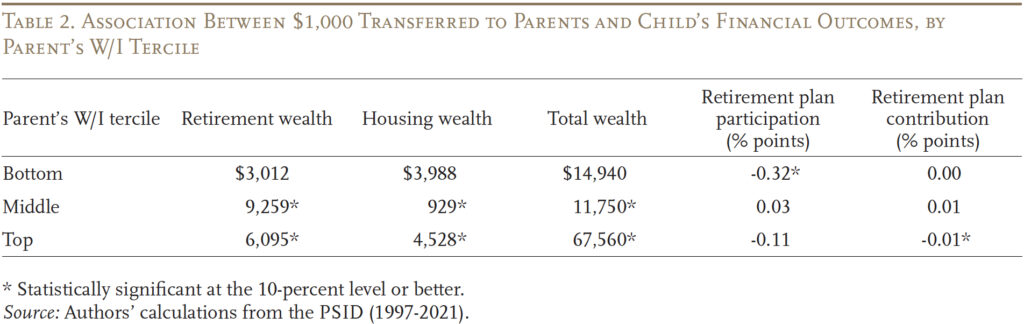
For example, among those who have parents in the middle W/I tercile, every $1,000 children give to their parents is associated with $9,300 more in retirement wealth, $900 in housing wealth, and $11,800 in total wealth. Interestingly, the transfers had very little correlation with retirement plan engagement, as measured by the child’s average lifetime participation and contribution rates.
It seems that while parents’ retirement preparedness is the biggest driver of whether children give, those who do give are, typically, those who can afford it.
Child’s Income Tercile
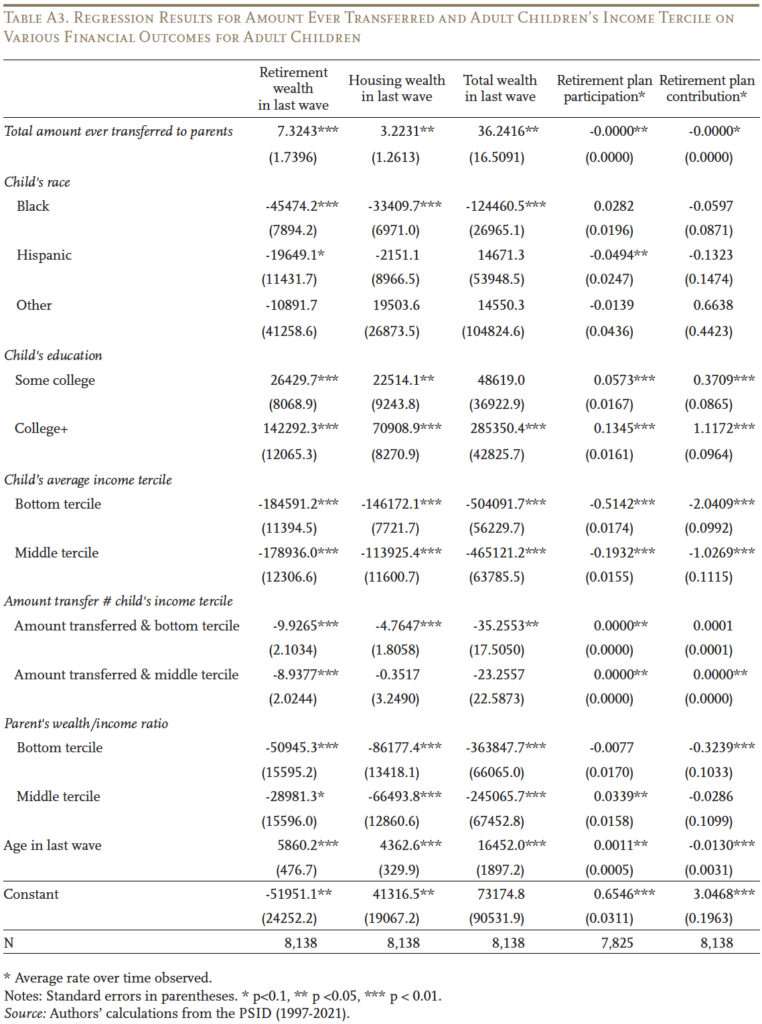
Children’s giving, on the other hand, may be related to how much they save in specific types of assets. Those in the bottom- and middle-income terciles who provide support to parents have slightly more total wealth than those who do not support parents, but they seem to have less allocated to housing and/or retirement assets (although these differences are not all statistically significant, see Table 3).12
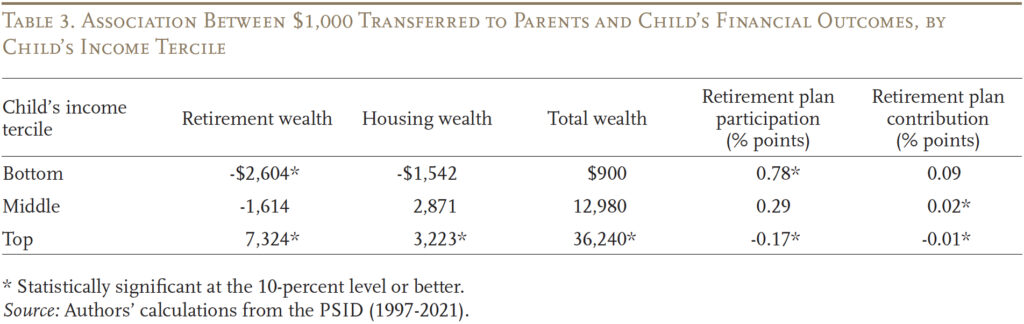
For example, among adult children in the bottom income tercile, every $1,000 that they give to parents is associated with $2,600 less in retirement wealth and $1,500 less in housing wealth, but almost $1,000 more in total wealth compared to their peers who do not give. Once again, transfers generally had little impact on average lifetime retirement plan participation and contributions.
These results suggest that while children who provide support may not be sacrificing their overall financial security, they may be allocating less of their savings to retirement accounts and housing. The intuition here is that these assets can be hard to tap if parents have urgent financial needs, so children may purposely be saving more in assets that are readily accessible.
Child’s Race/Ethnicity
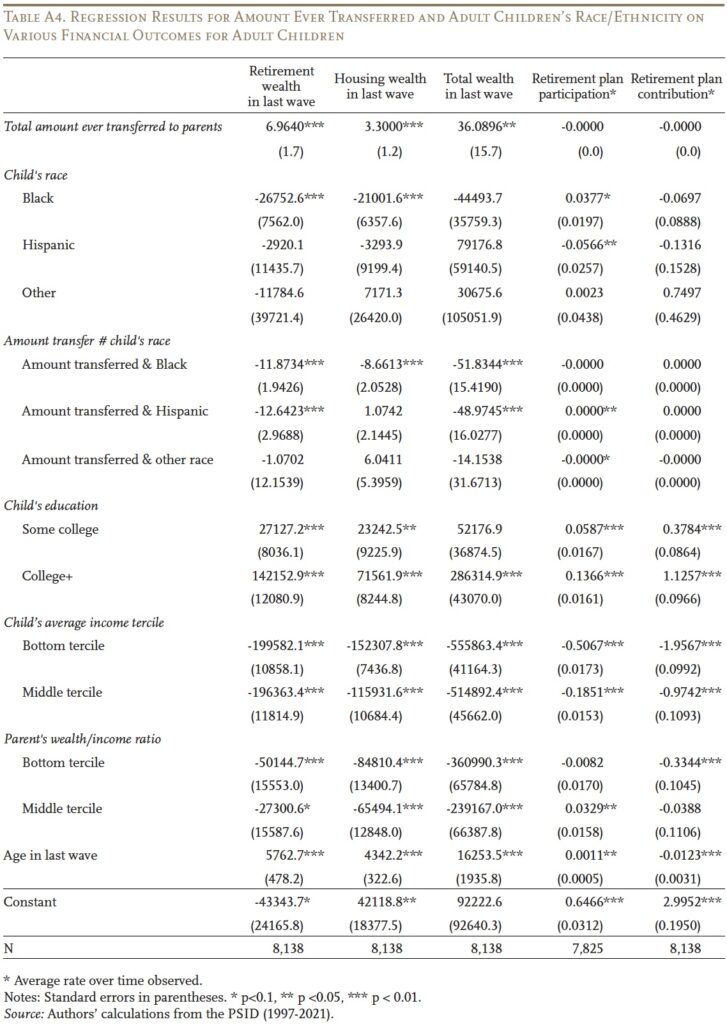
So far it seems that children are not sacrificing their own financial security when they support their parents. Unfortunately, the story is different by race/ethnicity. Adult children who are Black and Hispanic and provide financial support end up with $15,700 and $12,900 less in total wealth, respectively, than their non-giving peers (see Table 4).13 And while retirement plan participation is similar among givers and non-givers, givers end up with $5,000-$6,000 less in their retirement accounts. These results control for both child income and parent retirement preparedness, among other factors.
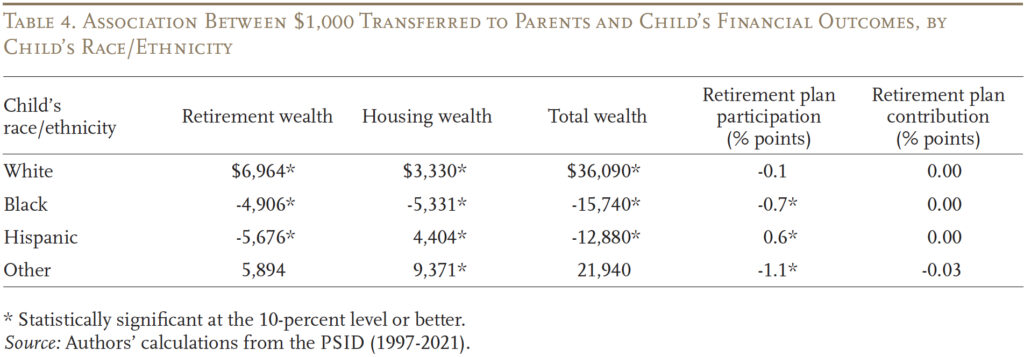
The differences in assets seem to have very little to do with average plan participation or contributions. Instead, one potential reason that Blacks and Hispanics who provide parental support end up being worse off than others could be the timing of financial transfers.14 Figure 2 plots cumulative lifetime transfers to parents from hypothetical adult children whose giving at various ages reflects average transfers by adult children of the same age and race/ethnicity in any given period.15 The implication is that while average retirement plan participation or contributions are similar, their savings may be backloaded later in their career. A delay in savings results in lower retirement wealth and total wealth.
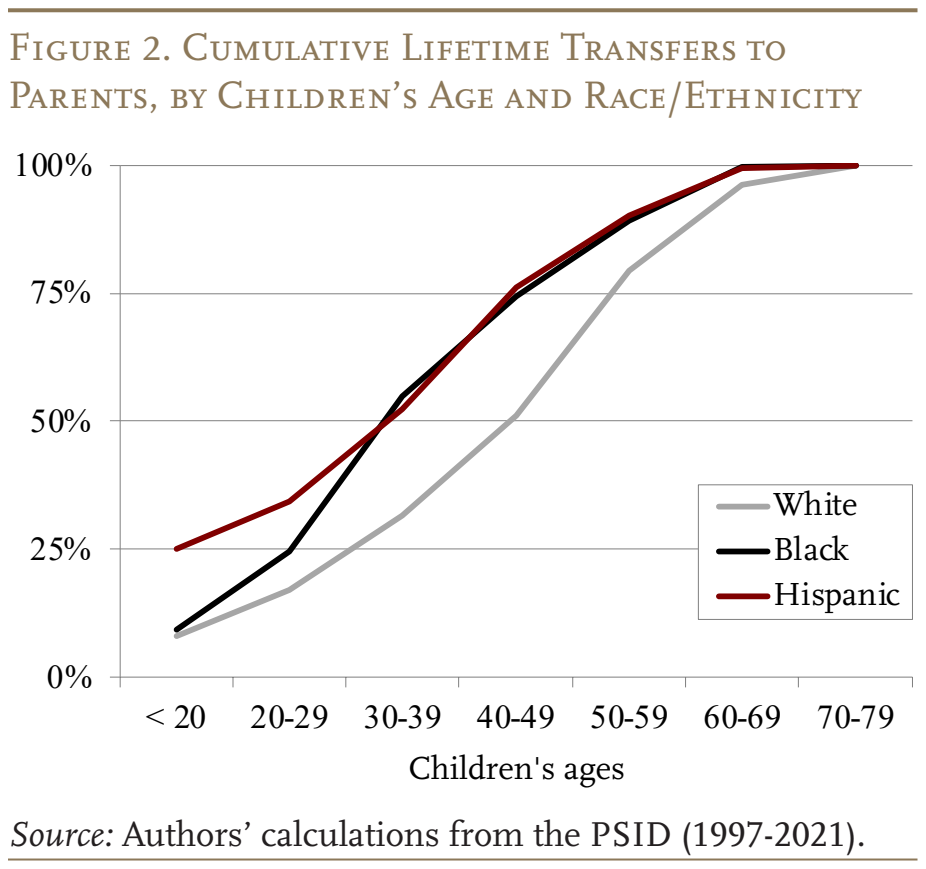
Hispanics typically begin transferring money at much younger ages. While Blacks do not start supporting their parents as early as Hispanics, they also tend to frontload their support. Their timing likely coincides more closely with when their parents are typically entering retirement.16 In contrast, Whites concentrate more of their transfers in their 50s and 60s, around the time when parents are more likely to need long-term care. These patterns matter, because giving to parents in early adulthood rather than later means losing out on decades of asset returns on money that otherwise could have been invested.
Conclusion
Many households arrive at retirement with limited financial resources outside of Social Security. When financial needs arise, some may rely on their children to cover the gap. Adult children providing financial support to retired parents may have to cut back on their own retirement savings, potentially making them more financially vulnerable later in life.
The good news is that, overall, children do not seem to be sacrificing their own financial security when they support their parents. The exception though, is for Blacks and Hispanics, where providing support to parents may be costing them financially. One potential reason is that they more often give money at younger ages, potentially resulting in decades of lost return compounding.
The results from this analysis have several important research and policy implications. First, they shed light on how falling short in retirement can have spillover effects on future generations. Second, child-to-parent transfers have important implications for predictions from lifecycle models, which historically have not taken into account such transfers. Third, 401(k) plan design options that limit withdrawals may result in children saving less in retirement accounts, because they anticipate that they may need to tap the money for family transfers while still working. Finally, raising the Social Security early eligibility age is often discussed as a way to help encourage people to work longer and potentially build up more saving. However, raising the earliest claiming age is a benefit cut for those with shorter than average life expectancy and it could also prolong the need for children to support their parents – both impacts could further exacerbate generational retirement insecurity.
References
Chen, Anqi and Alicia H. Munnell. 2023. “401(k)/IRA Holdings in 2022: An Update from the SCF.” Issue in Brief 23-25. Chestnut Hill, MA: Center for Retirement Research at Boston College.
Chiteji, Ngina S. and Darrick Hamilton. 2002. “Family Connections and the Black-White Wealth Gap among Middle-Class Families.” The Review of Black Political Economy 30(1): 9-28.
Choukhmane, Taha, Jorge Colmenares, Cormac O’Dea, Jonathan Rothbaum, and Lawrence Schmidt. 2023. “Who Benefits from Retirement Saving Incentives in the U.S.? Evidence on Racial Gaps in Retirement Wealth Accumulation.” Working Paper 2023-483. Ann Arbor, MI: University of Michigan Retirement and Disability Research Center.
Heflin, Colleen M. and Mary Pattillo. 2002. “Kin Effects on Black-White Account and Home Ownership.” Sociological Inquiry 72: 220-239.
Lanuza, Yader R. 2020. “Giving (Money) Back to Parents: Racial/Ethnic and Immigrant–native Variation in Monetary Exchanges During the Transition to Adulthood.” Sociological Forum 35(4): 1157-1182.
McKernan, Signe-Mary, Caroline Ratcliffe, Eugene Steuerle, and Sisi Zhang. 2014. “Disparities in Wealth Accumulation and Loss from the Great Recession and Beyond.” American Economic Review 104(5): 240-244.
Meschede, Tatjana, William Darity Jr., and Darrick Hamilton. 2015. “Financial Resources in Kinship and Social Networks: Flow and Relationship to Household Wealth by Race and Ethnicity among Boston Residents.” Community Development Discussion Paper 2015-02. Boston, MA: Federal Reserve Bank of Boston.
Morningstar, Defined Contribution Institutional Investment Association, and Aspen Institute 2023. “How Large are Racial and Gender Disparities in 401(k) Account Balances and What is Causing Them?” Collaborative for Equitable Retirement Savings (CFERS).
O’Brien, Rourke L. 2012. “Depleting Capital? Race, Wealth and Informal Financial Assistance.” Social Forces 91(2): 375-396.
Smythe, Andria. 2022. “Child-to-Parent Intergenerational Transfers, Social Security, and Child Wealth Building.” AEA Papers and Proceedings (112): 53-57.
Tan, Fu, Fiona Greig, Andrew S. Clarke, Kevin Khang, Kate McKinnon, and Victoria Zhang. 2023. “The Vanguard Retirement Outlook: A National Perspective on Retirement Readiness.” Valley Forge, PA: Vanguard.
University of Michigan. Panel Study of Income Dynamics, 1997-2021. Ann Arbor, MI.
Yin, Yimeng, Anqi Chen, and Alicia H. Munnell. 2024. “The National Retirement Risk Index: An Update from the 2022 SCF.” Issue in Brief 24-5. Chestnut Hill, MA: Center for Retirement Research at Boston College.
Zhong, Mingli. 2026. “How More People Are Supporting Their Aging Parents Financially, and How It Might Affect Their Financial Futures.” Urban Wire. Washington, DC: Urban Institute.
Endnotes
- Chen and Munnell (2023). Even for lower-income households, numerous studies have found that Social Security will not be sufficient in retirement. See Tan et al. (2023) and Yin, Chen, and Munnell (2024). ↩︎
- See Chiteji and Hamilton (2002); Heflin and Pattillo (2002); O’Brien (2012); McKernan et al. (2014); and Meschede, Darity, and Hamilton (2015). Adult Asian American and Pacific Islander children are also more likely to provide financial transfers to parents (Lanuza 2020), but their sample size in national surveys is often too small to study them separately. ↩︎
- See Chiteji and Hamilton (2002); Heflin and Pattillo (2002); and O’Brien (2012). ↩︎
- Choukhmane et al. (2022) and Morningstar, Defined Contribution Institutional Investment Association, and Aspen Institute (2023). ↩︎
- Smythe (2022). ↩︎
- Zhong (2026). ↩︎
- While the HRS also has parent-child dyads, it does not ask detailed financial or demographic information about adult children and only surveys parents starting at age 50. A limitation of the linked sample in the PSID is that it may not be representative of the current U.S. population. The PSID did add additional immigrant samples in the 1990s and early 2000s to improve representativeness, but those in the immigrant samples are less likely to be linked to their parents, so they cannot be used for our purposes. ↩︎
- The sample includes parent-child dyads in which the oldest parent is at least age 55. ↩︎
- The PSID has surveyed households and their children since 1968. However, over time, growing immigration made the survey less representative. To better capture post-1968 immigrant populations, the PSID added the 1990 Latino sub-sample and the 1997/1999 immigrant refresh. As a result, the linked parent-child sample would necessarily undersample Hispanic households since their parents would not have been included in earlier years of the survey. Therefore, the results for Hispanics should be viewed as a lower-bound estimate. ↩︎
- See Appendix Table A1 for more details. ↩︎
- The financial outcome for children with parents in the top W/I tercile is the coefficient for total amount ever transferred. For those with parents in the bottom or middle W/I tercile, the financial impact is derived by adding the coefficient for total amount ever transferred to the coefficient for amount transferred interacted with the respective parent W/I tercile. For the full regression, see Appendix Table A2. ↩︎
- Similarly, the financial outcome for children in the top-income tercile is the coefficient for total amount ever transferred. For those in the bottom- or middle-income tercile, the financial impact is derived by adding the coefficient for total amount ever transferred to the coefficient for amount transferred interacted with the respective income tercile. For the full regression, see Appendix Table A3. ↩︎
- See Endnotes 10 and 11 for a parallel explanation of how the differences by race/ethnicity are derived. The full regression is shown in Appendix Table A4. ↩︎
- Another potential reason is that selection into giving might differ by race/ethnicity – whereas propensity to give is positively correlated with household wealth for White households, it might be negatively correlated for Black and Hispanic households. ↩︎
- This thought experiment is similar to a period life table. While reflective of aggregate behavior in the community, specific individuals are unlikely to exhibit this giving pattern. ↩︎
- Smythe (2022) documents Black children supporting their parents in retirement, often until the parents can first claim Social Security at age 62. ↩︎
Appendix



Chen, Anqi and Nilufer Gok. 2026. "Does Giving Money to Your Parents Make You Less Financially Secure?" Issue in Brief 26-17. Chestnut Hill, MA: Center for Retirement Research at Boston College.