



Here’s How Much Americans Rely on Social Security – at All Income Levels






Alicia H. Munnell is a columnist for MarketWatch and senior advisor of the Center for Retirement Research at Boston College.
Social Security is really important for older Americans.
Every now and then, I am asked how dependent people are on Social Security. That’s actually an important question, given recent proposals for restructuring the program and concerns that the program is simply too big.
Fortunately, the Congressional Research Service recently reported on the importance of Social Security for individuals 65+, using data from the Health and Retirement Study, which is a longitudinal, nationally-representative survey of the population over age 50 that is conducted every two years through a combination of face-to-face and telephone interactions.
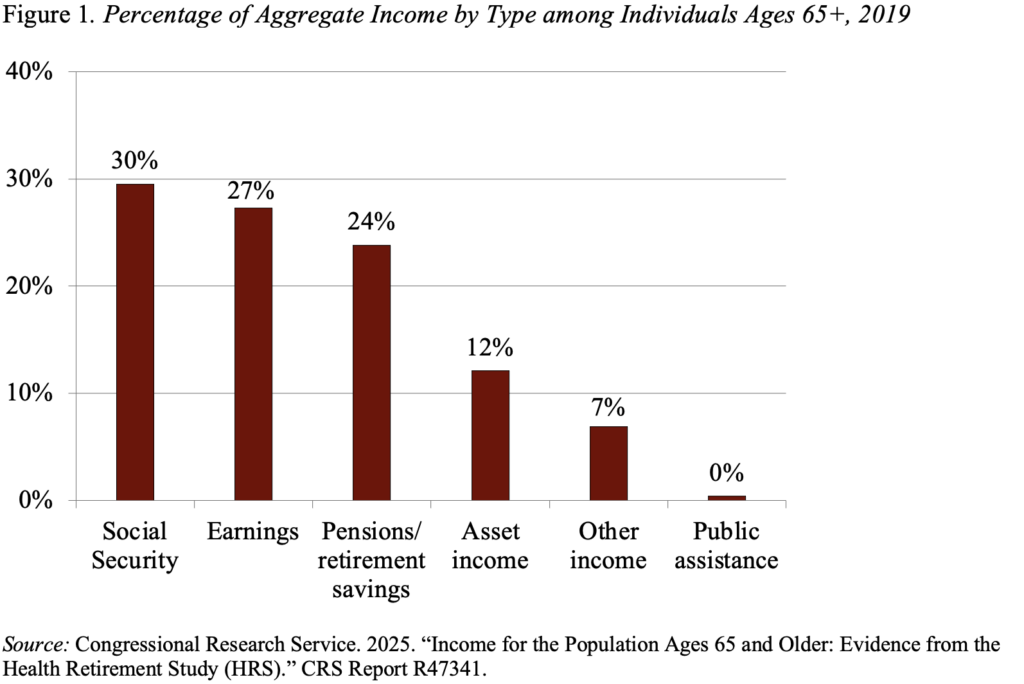
One way to look at the importance of Social Security is simply as a share of aggregate income among individuals 65+. In that regard, Social Security was definitely the largest single source in 2019 (see Figure 1). But Social Security was only a little ahead of earnings and income from pensions and retirement savings. Is Social Security at 30 percent of the income for those 65+ too big, too small, or just about right?
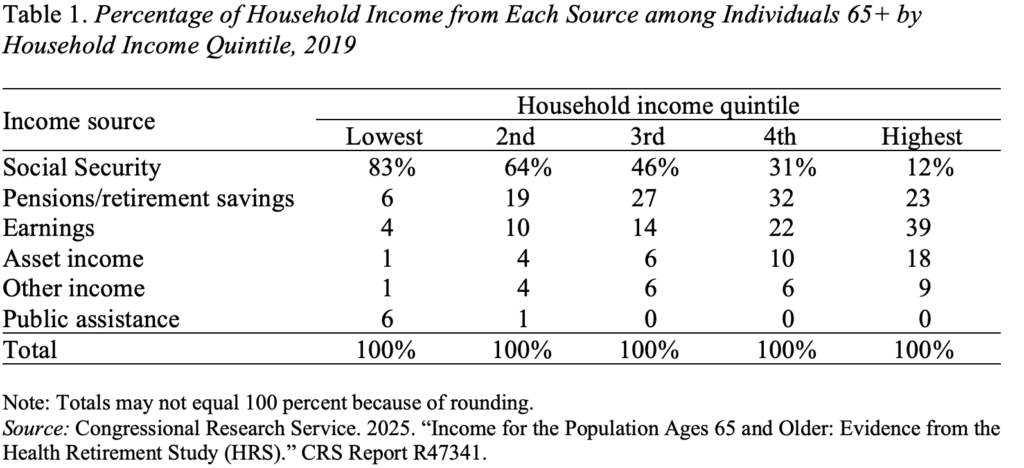
A more meaningful way to look at reliance on Social Security is by income group. Here, the results show an intuitive pattern. Social Security is hugely important for older Americans in the lowest quintile of the income distribution, accounting for 83 percent of the total income (see Table 1). For the second quintile, reliance on Social Security drops to 64 percent, with income from pensions/retirement savings taking up some of the burden and some earnings kicking in as well. By the time we get to the middle of the income distribution, reliance on Social Security falls to 46 percent, with income from pensions/retirement savings making a meaningful contribution. In the fourth quintile, Social Security is no longer the primary source of income, with income from pensions/retirement savings taking over the lead. Finally, at the highest income group, Social Security falls to fourth place, with earnings being the main source for this group.
What do these numbers say about the reliance of older Americans on Social Security? In terms of magnitude, are they too high or too low? On the one hand, the reliance of high-income households is very sensitive to the age of the sample. Most earnings disappear by age 75, so older high-income individuals end up more reliant on Social Security than these numbers suggest. On the other hand, a 2021 study by SSA economists showed that even the Health and Retirement Study tends to understate income from pensions and retirement savings and, therefore, those 65+ are less reliant on Social Security than the results suggest.
But assume the numbers are absolutely perfect, should we be happy or sad? Note, the numbers say nothing about adequacy; do low-income individuals have enough to live decently? My assessment of the results is that the system provides only a crumb in welfare-type benefits. It is about time to update the means-tested Supplemental Security Income program.
In terms of the highest-income group, I would like to see them receiving meaningful benefits, because it ensures solid political support for this important program. For those individuals in the three middle groups, income from pensions and retirement savings and from earnings makes an increasingly important contribution as income rises.
The findings show that Social Security is a really important program for older Americans. It is doing its job. It needs to be tweaked, not restructured. Let’s get the tweaking done.